

Imagine it’s 3:00 AM on a Tuesday when a pipe suddenly bursts under your kitchen sink. In our humid Myrtle Beach climate, standing water can trigger mold growth in as little as 24 to 48 hours according to EPA guidelines. We know the anxiety that sets in when you’re scrambling in the dark during a coastal storm, searching for a way to stop the flow. It’s a stressful situation that no homeowner wants to face alone. A quick response is your best defense against a water emergency shut off crisis that could lead to costly restoration repairs.
You probably already realize that every second the water runs, the potential for structural damage grows. That’s why we’re here to help you take control of your home’s safety. You’ll learn exactly how to locate and operate your main water shut-off valve to prevent catastrophic flood damage in your Grand Strand residence. We’ll walk you through identifying different valve types, explain which tools you need to keep on hand, and help you understand when it’s time to call our professional team at Hunter Plumbing Services LLC for an expert hand.
Key Takeaways
- Identify the specific locations for your main valve based on common Myrtle Beach home styles and foundation types.
- Master the operation of your water emergency shut off by learning the difference between ball valves and gate valves.
- Discover how to safely troubleshoot valves seized by local salt air corrosion using the “gentle tap” method.
- Understand why rapid action is critical in the Grand Strand heat to prevent minor leaks from turning into major mold issues.
- Learn the essential steps to take after the flow stops to protect your home and simplify the insurance claims process.
Why Every Myrtle Beach Homeowner Needs a Water Emergency Plan
Think of your water emergency shut off as the master switch for your entire home. Just as you’d flip a breaker to stop an electrical short, this valve kills the flow of water before it can destroy your floors and drywall. At Hunter Plumbing Services, we see many neighbors who only look for this valve when they’re already standing in two inches of water. It’s normal to feel a bit unsure about where yours is located, but in the Grand Strand, waiting until an emergency happens is a gamble you don’t want to take.
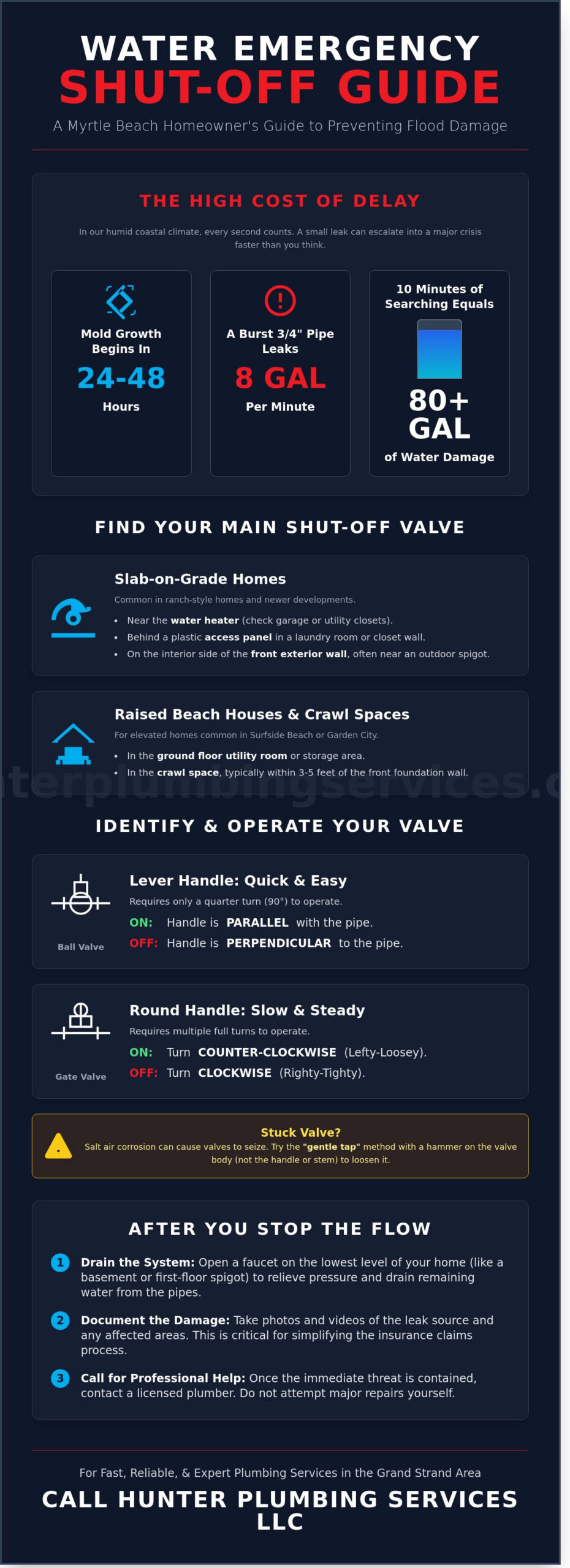
Our coastal environment puts unique pressure on residential plumbing. The high water table and local soil conditions mean your underground pipes face constant external shifts. Technically, understanding what a stopcock is helps you visualize this component; it’s a specialized valve designed to halt the flow of liquid through a pipe completely. In a coastal town like Myrtle Beach, minutes matter more than in drier climates. With average summer humidity levels often exceeding 80%, moisture trapped in your walls after a leak creates a perfect breeding ground for mold in as little as 24 hours.
The Real Cost of Delayed Action
A standard 3/4-inch burst pipe can discharge approximately 8 gallons of water per minute. If you spend ten minutes hunting for a flashlight and searching the crawlspace, your home just absorbed 80 gallons of water. For our seasonal residents and snowbirds, the risk is even higher. Salt air is highly corrosive and can weaken older galvanized or copper lines over several decades, leading to pinhole leaks that quickly turn into major floods while you’re away for the season.
When to Use Your Emergency Shut Off
You should reach for your water emergency shut off the moment you notice red flags like a sudden drop in water pressure, the sound of rushing water behind a wall, or a water meter dial that spins while every faucet is closed. While most toilets and sinks have individual supply stops, those won’t help if a main line or a water heater fails. We recommend following these steps:
- Identify the difference: Fixture shut-offs only control one appliance; the main valve kills everything.
- Check the meter: If the leak is invisible, a spinning meter dial confirms you have a pressurized leak.
- Vacation prep: Always turn off the main valve if you plan to leave your Myrtle Beach property vacant for more than three days.
- Listen for clues: Unexplained damp spots on the floor or “ghost flushing” sounds often signal a need for an immediate shutdown.
Knowing the location of this valve provides immediate peace of mind. It transforms a potential catastrophe into a manageable repair that our family-owned team can handle quickly and transparently.
Where is My Main Water Shut-Off Valve? (Grand Strand Edition)
Every home along the Grand Strand has a unique layout, which means your water emergency shut off location depends heavily on when and how your house was built. Finding this valve before a pipe bursts is the best way to protect your property. In Myrtle Beach, most residential plumbing follows a few predictable patterns based on the foundation type. You should start your search by walking the perimeter of your home, specifically looking at the side that faces the street.
Finding the Valve in Slab-on-Grade Homes
Many ranch-style homes in Conway and newer developments in Carolina Forest sit on concrete slabs. In these houses, the main shut-off valve is usually located near the water heater. Check your garage first. Look for a pipe emerging from the floor or wall near the tank. If it is not there, head to the laundry room. Builders often hide the valve behind a small plastic access panel in the wall. In about 75% of local slab homes built after 2005, the valve is located on the interior side of the front exterior wall, often directly behind an outdoor spigot. Look for a lever or a circular handle that looks different from your washing machine connections.
Locating Valves in Raised Beach Houses and Crawl Spaces
Raised beach houses in areas like Surfside Beach or Garden City present a different challenge. Since the living quarters are elevated, the plumbing is often exposed underneath. Check the “ground floor” utility room or storage area first. If your home has a traditional crawl space, the water emergency shut off is typically located within 3 to 5 feet of the front foundation wall. Look for pipes wrapped in black heat tape; this is a common sight in our region to prevent rare deep freezes. Following the main line from the ground up into the floorboards will lead you to the valve. Understanding what to do after you stop the flow is just as important as finding the handle, as standing water can quickly damage local building materials like OSB and drywall.
The Street-Side Meter Box
If you cannot find an internal valve, your last resort is the city meter box. This is a rectangular lid made of concrete or heavy plastic located near your property line or sidewalk. You will likely need a “meter key,” which is a long metal tool available at local hardware stores, to open the lid and turn the valve. While this valve technically belongs to the city utility provider, you are permitted to use it in dire emergencies to stop a flood. If you find that your home lacks a working interior shut-off, the team at Hunter Plumbing Services can install a modern ball valve for easier access. For North Myrtle Beach high-rises, this process is different; your valve is usually located in a utility closet near the entrance or under the kitchen sink, as individual units rarely have street-side access.
Step-by-Step: How to Use Your Water Emergency Shut Off
When a pipe bursts, every second counts. Your first priority is reaching the water emergency shut off without delay. Before you attempt to turn any handles, clear away any boxes, insulation, or debris blocking the area. You need enough room to grip the handle firmly and maintain your balance. If you aren’t sure where to look, the Regional Water Providers Consortium offers a helpful guide on how to find your emergency water shut-off valve quickly. Once you are at the valve, move with steady, firm pressure. Never jerk a handle that has stayed in one position for years. A sudden jolt can cause older metal components to snap or leak.
Operating a Ball Valve (The Lever)
Most modern homes use a ball valve. It features a straight lever handle that is easy to identify. To stop the flow, turn the lever 90 degrees. When the handle is parallel to the pipe, the water is on. When it’s perpendicular to the pipe, forming a “T” shape, the water is off. These valves are highly reliable. In coastal environments, they resist corrosion better than older styles. They only require a quarter-turn, making them the fastest option during a crisis.
Operating a Gate Valve (The Wheel)
Older homes often have gate valves. These look like a round wheel, similar to a garden hose spigot. This mechanism lowers a metal gate to block the water flow. To close it, follow these steps:
- Turn the wheel clockwise until it stops completely.
- Use the “righty-tighty” rule to remember the direction.
- Count the number of full rotations to ensure the gate is fully seated.
Be careful not to over-tighten the wheel. Old metal can become brittle over time. If the valve feels stuck, apply steady force rather than a sudden yank. Forcing a seized gate valve can lead to a broken stem, which creates a much larger problem for your home.
Relieving Pipe Pressure
Shutting the valve stops new water from entering, but your pipes still hold gallons of pressurized liquid. You must drain the system to stop the leak at the burst point. Go to the lowest point in your house, which is usually an outdoor hose bib, and open it fully. Next, go to the highest faucet in the house and turn it on. This lets air into the lines so the remaining water can drain out the bottom. Taking this step prevents further water damage while you wait for a repair.
Finally, verify that the water emergency shut off worked. Check a kitchen or bathroom faucet. If the flow stops after a few seconds, you’ve successfully secured your home. Now you can focus on cleaning up the mess and calling a trusted professional to fix the underlying issue.
Troubleshooting: Stuck Valves and Salt Air Corrosion
Living along the Grand Strand brings beautiful views, but the salt air is a constant threat to your home’s metal components. In Myrtle Beach, the most common reason a water emergency shut off fails is metal-on-metal seizing. Over time, salt and moisture create a chemical bond between the valve stem and the packing nut. This makes the metal feel like it’s welded shut. If you haven’t turned your valve in 2 or 3 years, expect some resistance.
If the handle won’t budge, don’t use raw strength. You might snap the internal stem. This turns a minor inconvenience into a major flood. Try the gentle tap method first. Use a small wrench or hammer to lightly tap the valve body. These vibrations can often break the micro-bonds of corrosion. You can also apply a penetrating oil like WD-40 or PB Blaster. Let the oil sit for at least 15 minutes before trying to turn the handle again. If it still won’t move after three attempts, stop immediately to avoid a pipe rupture. If this happens late at night or on a weekend, you’ll want to have the number of a reliable after hour plumbing service in Myrtle Beach ready so you can get professional help without delay.
Dealing with Corroded Gate Valves
Many homes built in Horry County before 2005 rely on gate valves. These use a round handle to lower a metal gate into the path of the water. These are notorious for failing internally. You might see verdigris, which is a crusty green oxidation on the metal. This is a clear sign of a slow leak and structural weakness. Sometimes the handle will spin freely without actually lowering the gate. If your handle spins but the water keeps flowing, the internal stem has likely detached from the gate.
The Importance of a Meter Key
Every homeowner in our area should own a T-handle meter key. You can find these at local hardware stores for about $20. If your main house valve is stuck or broken, this tool allows you to turn off the water at the city meter near the street. It’s your ultimate backup during a water emergency shut off scenario. Simply fit the U-shaped end over the valve flange in the meter box and turn it 90 degrees until the two padlock holes align. This stops the flow before it reaches your house lines.
If your old valve is crusty, green, or stuck, don’t wait for a flood to find out it doesn’t work. The team at Hunter Plumbing Services can help install a new, easy-to-turn ball valve that provides total peace of mind for your home.
Beyond the Valve: What to Do After You Stop the Flow
Once you have successfully completed the water emergency shut off, the immediate threat is over, but the recovery process is just starting. Your first move is to document everything. Take clear photos and videos of the standing water and damaged property before you start cleaning up. Insurance companies often process claims 25% faster when they have visual evidence from the moment the incident occurred. This documentation serves as your proof of the extent of the leak.
Next, protect your appliances. If your main valve is closed, your water heater might still be running. Without water flowing through the tank, electric heating elements can burn out in minutes, and gas units can overheat. Flip the dedicated breaker in your electrical panel or turn the gas control knob to the “off” or “pilot” position. This simple step prevents a plumbing leak from turning into an expensive appliance replacement.
Addressing moisture is the most critical step for South Carolina homeowners. Myrtle Beach often sees outdoor humidity levels exceeding 75%, which means indoor moisture won’t evaporate on its own. Mold spores can begin to colonize damp drywall and flooring within 24 to 48 hours. You need professional-grade dehumidification to pull deep-seated moisture out of your home’s structure. Household fans aren’t enough to stop mold growth in our coastal climate.
Plumbing Repair and Restoration
Coastal plumbing faces unique challenges like salt air corrosion and shifting sandy soil. A quick DIY patch or a piece of tape won’t provide a long-term solution for your pipes. You need a permanent fix to prevent the next water emergency shut off scenario. Contact an emergency plumber myrtle beach to inspect the system and perform a code-compliant repair. Many local homeowners are now installing whole-house leak detection systems. These smart devices monitor your flow and can automatically shut off your water if they detect a burst pipe, potentially saving thousands in restoration costs. For property owners interested in advanced residential or commercial systems, UTD Technology Corp provides professional technology solutions that enhance overall safety and monitoring.
Preventative Maintenance for Peace of Mind
Avoid future stress by practicing the “Annual Turn.” Once a year, fully close and reopen your main valve to ensure it hasn’t seized up from mineral buildup. This simple habit ensures the handle will actually move when you need it most. You should also label the valve with a bright tag so guests or renters can find it during a crisis. Vacation rental owners especially benefit from pairing this habit with a trusted after hour plumbing provider in the Grand Strand who can respond quickly when a leak strikes outside of normal business hours. A professional plumbing inspection every 12 months can identify corroded supply lines or weak valves before they fail, keeping your home dry and your family safe.
Take Control of Your Home’s Safety
Knowing the exact location of your water emergency shut off is the most effective way to prevent major property damage. You should test your main valve at least once every 12 months to ensure the salt air hasn’t caused critical parts to seize up. If your valve is stuck or you notice a leak, acting quickly can save you from the high costs of structural repairs. According to the Insurance Institute for Business & Home Safety, water damage is one of the most common and costly home insurance claims, making your quick response vital. Our team at Hunter Plumbing Services brings family-owned expertise to every job across Horry County. We understand the unique plumbing pressures of the Grand Strand and provide 24/7 support when you need it most. We specialize in coastal plumbing challenges and ensure your systems remain reliable year after year.
Need an emergency plumber in Myrtle Beach? Contact Hunter Plumbing Services 24/7!
Keep this guide handy so you’re always prepared for the unexpected. You’ve taken the right steps to protect your property and your peace of mind today.
Frequently Asked Questions
Where is my water shut off valve if I live in a Myrtle Beach condo?
In a Myrtle Beach condo, your shut-off valve is typically located under the kitchen sink, in the laundry room, or inside the water heater closet. Local building codes require these valves to be accessible for a quick water emergency shut off. Check the wall behind your washing machine or the area where the main cold water line enters your unit. If you can’t find it, ask your HOA for the specific layout of your 1990 or newer floor plan.
What tool do I need to turn off the water at the street?
You need a T-handle water meter key to turn off the water at the street. These tools are usually 28 to 36 inches long and fit over the rectangular nut on the city’s valve. If you don’t have a meter key, a large pair of adjustable pliers and a sturdy screwdriver can work. Place the screwdriver through the pliers’ handles to create leverage for the turn. This ensures a reliable water emergency shut off during a major leak.
Can I use WD-40 on a stuck water main valve?
You can use WD-40 on a stuck valve, but a specialized penetrating oil like PB Blaster works 50 percent faster on heavy corrosion. Spray the lubricant directly onto the valve stem and let it sit for 15 minutes before attempting a turn. Never force a stuck valve with a hammer or heavy wrench. If it doesn’t budge after two applications, call our team to avoid snapping the pipe. We’ll ensure your home stays dry and safe.
Do I need to turn off my water heater after shutting off the main water?
You should turn off your water heater immediately after closing the main valve to prevent the heating elements from burning out. If the tank drains while the power is on, the dry elements can fail in less than 5 minutes. Flip the dedicated breaker in your electrical panel for electric models. For gas heaters, turn the thermostat dial to the Pilot or Vacation setting. This simple step protects your equipment from costly damage during repairs.
Why is my water still running after I turned the main valve off?
Your water is likely still running because of residual pressure trapped in the pipes. Open the lowest faucet in your home to drain the remaining 2 to 5 gallons of water quickly. If the flow doesn’t stop after several minutes, your main valve has a faulty seal. This is a common issue in gate valves older than 20 years. A failing valve won’t provide a complete seal, meaning it’s time for a professional replacement to regain control.
How much does it cost to have a plumber replace a main shut-off valve?
According to 2024 industry data from Angi, the average cost to replace a main shut-off valve ranges from 200 to 600 dollars. This price depends on the valve type and the accessibility of your plumbing. Hunter Plumbing Services provides transparent, upfront pricing for every job we handle. We make sure you know the exact cost before we start any work on your home. Our family-owned business values honesty and clear communication with every neighbor we serve.
Is the city responsible for the water shut-off valve near the curb?
The city is responsible for the valve located inside the meter box and the line leading to the street. However, the homeowner is responsible for the customer side valve and all piping that runs from the meter to the house. If the city’s valve is leaking, contact your local utility department immediately. If the leak occurs on your side of the meter, you’ll need a licensed plumber. We can help identify exactly where the responsibility lies during our inspection.