

Last July, a homeowner in The Market Common discovered that their “endless” hot water had turned into a lukewarm trickle just as their summer guests arrived. It’s a frustrating situation, especially when you’ve invested in high-end equipment to avoid exactly this problem. You likely chose a tankless system for its efficiency and 20 year life expectancy, but our coastal environment creates unique hurdles. Between the high mineral content in local water and the corrosive salt air, your system works harder than one in a landlocked state.
Understanding how often to flush tankless water heater units in Myrtle Beach is essential for preventing fluctuating temperatures and high utility bills. Most manufacturers suggest annual service, but our specific water conditions often require a 9 month maintenance schedule to prevent scale buildup. This guide outlines the exact plan you need to protect your unit and ensure you don’t face an emergency repair during the peak of vacation season. We’ll cover the signs of mineral deposits and the steps to keep your hot water flowing reliably for your family.
Key Takeaways
- Protect your home’s efficiency by learning how Myrtle Beach’s unique coastal mineral profile affects your heat exchanger.
- Find out exactly how often to flush tankless water heater systems to avoid the 6-month accelerated scale buildup common in South Carolina.
- Identify the subtle warning signs of mineral choking, such as inconsistent temperatures and the dreaded “cold water sandwich” effect.
- Discover how regular descaling prevents thermal stress and metal fatigue, saving you from costly premature unit replacements.
- Learn about the Hunter Plumbing Services LLC “Coastal Protection” approach that goes beyond a basic flush to keep your hot water reliable year-round.
Table of Contents
- Why Flushing Your Tankless Water Heater Matters in Myrtle Beach
- Determining Your Ideal Flushing Schedule: 2026 Standards
- Hard Water vs. Soft Water: The Science of Scale
- Warning Signs Your Tankless Unit Needs Immediate Flushing
- The Hunter Plumbing Approach: Reliable Coastal Maintenance
Why Flushing Your Tankless Water Heater Matters in Myrtle Beach
If you live in Myrtle Beach, you know our coastal environment is unique. While tankless units offer the luxury of endless hot water, they require specific care to survive the Grand Strand’s conditions. Flushing is the essential process of circulating a food-grade descaling solution through the unit’s heat exchanger. This procedure removes the mineral scale that naturally accumulates during operation. Understanding how tankless water heaters work helps you see why this maintenance is vital for your home. Without it, microscopic scale buildup acts as a silent killer. It restricts water flow and forces the unit to work harder, eventually leading to catastrophic heat exchanger failure. Local homeowners often ask us how often to flush tankless water heater systems to avoid these expensive breakdowns.
The Impact of Horry County Water Hardness
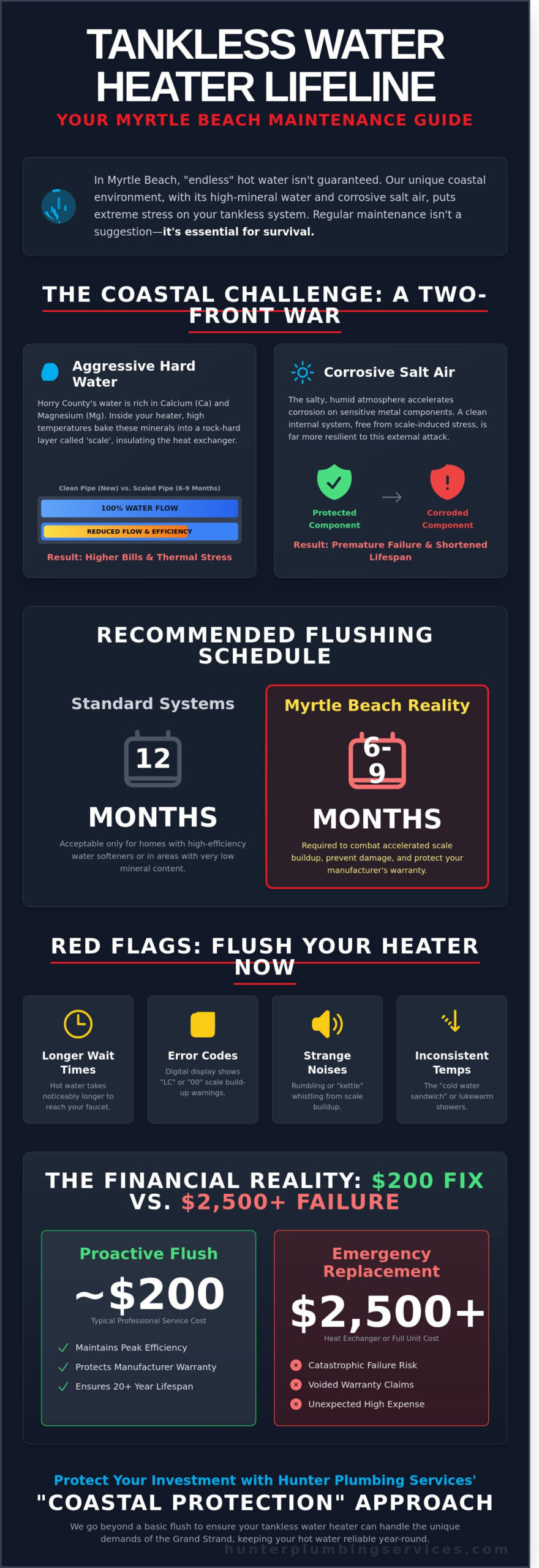
Horry County water contains specific levels of calcium and magnesium that vary by neighborhood. When these minerals encounter the high temperatures inside your unit, they undergo a chemical reaction. They “bake” onto the internal copper or stainless steel surfaces, creating a rock-hard layer. Scale is the primary enemy of tankless efficiency. As this layer thickens, it creates a thermal barrier between the burner and the water. This means your unit stays on longer and uses more gas or electricity to reach the same temperature. In Myrtle Beach, the mineral profile can be aggressive, making regular maintenance a necessity rather than a suggestion.
Heat Exchanger Longevity and Salt Air
Living near the ocean means dealing with salt air every day. This salty atmosphere can lead to premature pitting and corrosion on sensitive copper components. A clean internal system is more resilient against these external environmental stresses. When your heat exchanger is free of scale, it operates at lower internal temperatures, which reduces the stress on the metal. This balance is critical for homes within five miles of the coast. The financial logic is also clear. According to industry averages, a professional maintenance flush typically costs around $200. In contrast, a full heat exchanger replacement can exceed $2,500. Determining how often to flush tankless water heater units depends on your specific water quality, but doing it regularly saves you thousands over the life of the appliance. We want to ensure your home stays comfortable without the shock of a preventable equipment failure.
Determining Your Ideal Flushing Schedule: 2026 Standards
Deciding how often to flush tankless water heater units depends on your specific water quality and how much hot water your family uses daily. While the general industry baseline remains 12 months, local conditions in South Carolina often demand a more aggressive approach. For 2026, manufacturers like Rinnai and Navien have updated their warranty guidelines. They now frequently require documented proof of annual or semi-annual maintenance to honor claims on heat exchangers. If you skip these services, you risk voiding a warranty that could save you thousands of dollars later.
When Once a Year is Sufficient
A standard 12-month flushing schedule works well for homes that have proactive water treatment in place. If you’ve installed a whole house filtration system or a high-efficiency water softener, your tankless unit is already protected from the harshest minerals. These systems strip out the calcium and magnesium that cause scale before the water ever reaches your heater. You can also use your unit’s smart diagnostic panel to monitor your “hours of operation.” If your household is small and your run-time is low, a professional flush every 12 months will keep your system running at peak efficiency.
Why Coastal Homes Often Need a 6-Month Flush
Myrtle Beach and Conway homeowners face unique challenges due to our local geography. The Science of Hard Water explains how dissolved minerals like calcium and magnesium create a rock-hard scale inside your plumbing. In our region, water hardness levels can be significantly higher than the national average. This mineral content, combined with sediment from older coastal infrastructure, creates a thick layer of insulation inside your heat exchanger. This layer forces your unit to burn more gas or electricity to reach the same temperature. You should consider a 6-month schedule if you notice any of the following:
- Your water takes longer to get hot than it did six months ago.
- The unit makes a low rumbling or “tea kettle” whistling sound during use.
- You see a “LC” or “00” scale build-up code on your digital display.
- Your monthly energy bills have increased by 10% or more without a change in usage.
High-occupancy properties, especially vacation rentals in North Myrtle Beach, almost always require the 6-month accelerated schedule. These units often run for several hours a day during the peak summer season. The constant flow of hard water through the system accelerates scale accumulation. If you manage a rental, a quick maintenance call to the team at Hunter Plumbing Services can prevent an embarrassing “no hot water” complaint from a guest. Staying ahead of the scale ensures your unit lasts its full 20-year expected lifespan rather than failing early due to neglect.
Hard Water vs. Soft Water: The Science of Scale
Understanding the science of scale helps you protect your investment. When cold water hits the hot heat exchanger inside your unit, a chemical reaction occurs. Heat causes dissolved minerals like calcium and magnesium to precipitate out of the water. These minerals solidify and bond to the metal fins and pipes. This chalky buildup acts as an insulator, which is exactly what you don’t want in a high-efficiency appliance.
This buildup creates a massive efficiency gap. Data from the Department of Energy indicates that just 1mm of scale can increase your water heating energy costs by up to 15%. Because the scale blocks the heat transfer, the unit stays on longer to reach the temperature you set on the thermostat. This extra run time puts your heater under intense thermal stress. The metal components expand and contract more than they were designed to, leading to metal fatigue and eventual cracks in the heat exchanger. In a coastal environment like Myrtle Beach, “soft” water isn’t always pure water. It can still contain high levels of dissolved solids that contribute to this degradation over time.
Identifying Hard Water in the Grand Strand
Myrtle Beach water quality varies depending on whether you are on municipal lines or a private well. You can identify mineral issues by checking your bathroom fixtures. If you see white, crusty buildup on your showerhead or faucets, that same scale is forming inside your tankless unit. You can also perform a simple home test by shaking a bottle of water with a few drops of dish soap. If the water remains cloudy and lacks suds, your mineral content is high. Reviewing the latest Grand Strand Water & Sewer Authority reports will help you determine how often to flush tankless water heater units in your specific neighborhood.
How Filtration Changes Maintenance Needs
Filtration is your first line of defense against scale in South Carolina. Many homeowners choose scale inhibitors or traditional salt-based softeners to treat incoming water. A scale inhibitor doesn’t remove minerals but changes their structure so they cannot stick to the metal surfaces of your heater. Using these systems can reduce the chemical intensity required during your annual maintenance. If you have a high-quality filtration system in place, it directly impacts how often to flush tankless water heater components, potentially extending the time between deep cleans. For homeowners in other regions facing similar mineral issues, such as those in North Texas, you can discover Your Water Guy to learn about specialized residential filtration. However, even with filtration, a regular checkup ensures no sediment has bypassed your filters to settle in the heat exchanger.
Warning Signs Your Tankless Unit Needs Immediate Flushing
Your tankless water heater usually works behind the scenes without much fuss. However, hard water minerals in Myrtle Beach don’t take a day off. While you might wonder how often to flush tankless water heater systems to stay ahead of trouble, your unit often provides physical clues that it’s overdue for maintenance. Ignoring these signs can lead to a 25% drop in efficiency or a total system lockout.
The “Cold Water Sandwich” is often the first red flag. This happens when scale buildup on the heat exchanger prevents the unit from maintaining a steady temperature. You might experience a burst of hot water, followed by a sudden cold gap, before it warms up again. This inconsistency means the sensors are struggling to read the water flow through the mineral crust.
Keep an ear out for strange sounds. If you hear rumbling, popping, or “kettling” noises, it isn’t a ghost in your pipes. It is water trapped behind layers of calcium deposits. As that trapped water turns to steam, it creates a localized pressure pocket that makes a distinct banging sound. Other signs include:
- Decreased water pressure: Scale can physically choke the narrow copper pathways, reducing your flow rate by up to 30%.
- Increased ignition time: If your unit takes longer to fire up, minerals are likely coating the flame rod or ignition sensors.
- Frequent cycling: The unit turns on and off rapidly because it can’t properly vent heat through the scale.
Decoding Common Error Codes
Modern units are smart enough to tell you when they’re struggling. On Rinnai units, Code 11 or Code 12 typically points to ignition or flame failure, often caused by mineral buildup on the internal sensors. Navien units might display Code E011 or E012 for similar issues. These error codes are the unit’s “SOS” for professional descaling. If you see these numbers flashing, the damage to your efficiency has already started. Understanding how often to flush tankless water heater units is about more than a calendar; it’s about responding to these digital warnings before the heat exchanger cracks.
DIY Flushing vs. Professional Service
Many homeowners attempt a DIY flush using a bucket and a pump. While using food-grade white vinegar with 5% acidity is standard, mistakes are easy to make. Using industrial acids can corrode the copper heat exchanger instantly. A Hunter Plumbing professional flush goes deeper than a simple vinegar soak. We clean the cold water inlet filter, inspect the fan blade for debris, and test the flame rod for accuracy. This professional documentation is vital for your 2026 home insurance records and maintains your 15-year manufacturer warranty. Most warranties explicitly state that failure due to scale buildup is not covered without proof of annual maintenance.
Don’t wait for an error code to leave you with a cold shower. Contact the local experts at Hunter Plumbing Services to schedule your professional tankless flush today.
The Hunter Plumbing Approach: Reliable Coastal Maintenance
Hunter Plumbing Services serves Horry County with a commitment to neighborly service and technical precision. We understand that Myrtle Beach water carries a specific mineral profile influenced by our local water tables. This makes knowing how often to flush tankless water heater units a critical part of homeownership in South Carolina. While most manufacturers suggest an annual service, our “Coastal Protection” maintenance check goes beyond a basic flush. We evaluate the entire health of your system to combat the unique challenges of living near the Atlantic.
Our family-owned team believes in transparency. We provide upfront pricing before any work begins. You won’t find hidden fees or surprise costs on your invoice, even for emergency after-hours calls. We’ve built our reputation on being a dependable local partner. We treat every home in the Grand Strand with the same care we give our own families. Our technicians use their deep knowledge of local plumbing codes and environmental factors to ensure your heater runs efficiently for its full 20 year lifespan.
What to Expect During a Professional Flush
A professional service visit is a detailed process that ensures every component of your unit is optimized. Our technicians follow a rigorous protocol:
- Isolation and Circulation: We shut off the gas and water valves to isolate the unit. We then circulate a food-grade descaling solution through the heat exchanger for 45 to 60 minutes to dissolve scale.
- Neutralizing and Cleaning: We flush the system with fresh water to remove all chemicals. We also pull and clean the inlet water filter, which often traps grit from the city water main.
- Venting Inspection: In our coastal environment, salt air and humidity can lead to debris or corrosion in the exhaust vents. We clear any obstructions to prevent backdrafting.
- Performance Testing: We restart the unit and measure the gallons per minute (GPM) flow. This ensures your unit provides the exact temperature and pressure you expect.
Scheduling Your Peace-of-Mind Service
Managing home maintenance shouldn’t be a source of stress. We offer recurring maintenance plans so you can stop worrying about how often to flush tankless water heater systems and focus on the comfort of your home. Being a Hunter Plumbing priority customer in the Grand Strand means you get faster service during peak seasons and the security of knowing your equipment is in expert hands. Regular descaling can improve your heater’s efficiency by up to 15 percent, saving you money on monthly utility bills.
Protect Your Myrtle Beach Hot Water Supply
Maintaining your home’s tankless unit doesn’t have to be a guessing game for your family. While 2026 industry guidelines recommend annual maintenance for coastal areas, the high mineral content found in Myrtle Beach water often accelerates scale buildup inside your heat exchanger. Determining how often to flush tankless water heater units depends on your specific household usage and local water hardness levels. Ignoring these 12 month intervals can lead to sudden system failures or significant efficiency drops that increase your monthly utility bills. As a local, family owned and operated business, we prioritize your home’s comfort and long term safety. We provide 24/7 emergency service across Horry County and offer upfront transparent pricing so you’re never surprised by the bill. Don’t wait for a cold shower or a loud heating element to remind you that your unit needs professional attention. Our team brings the technical expertise and neighborly care required to keep your water flowing at peak performance for years to come.
Keep your hot water flowing; book your Myrtle Beach tankless service now!
Frequently Asked Questions
Can I flush my tankless water heater myself?
Yes, you can perform a flush if you have a submersible pump, two stainless steel hoses, and 4 gallons of food-grade white vinegar. The process requires you to isolate the unit using the service valves and circulate the vinegar for at least 45 minutes. Many Myrtle Beach homeowners prefer professional service because a single mistake with the valves can damage the heat exchanger or flood your mechanical room.
What happens if I never flush my tankless water heater?
Scale buildup will cause your unit to fail prematurely and eventually stop heating water altogether. Calcium and magnesium deposits insulate the heating elements, which forces the system to work 30% harder to reach the desired temperature. If you’re unsure how often to flush tankless water heater systems in our coastal area, the standard is once every 12 months. Neglecting this leads to cracked heat exchangers and expensive repairs that manufacturers won’t cover under warranty.
How long does a professional tankless flush take?
A professional service appointment typically lasts between 60 and 90 minutes. This timeframe includes the 45-minute circulation cycle required to dissolve hard water minerals effectively. Our technicians use the remaining time to clean the intake filter, check the venting system, and test the unit’s performance to ensure everything is running at peak efficiency.
Does a water softener eliminate the need for flushing?
A water softener reduces the frequency of maintenance but doesn’t eliminate the need for a flush. Softeners remove about 98% of minerals, but the remaining 2% still accumulates over time in the narrow copper heat exchanger. You should still consult an expert to determine how often to flush tankless water heater units in your specific neighborhood, as even softened water can leave trace deposits over a 24-month period.
Is white vinegar the best solution for flushing a water heater?
Yes, food-grade white vinegar is the safest and most effective solution for residential tankless systems. It is acidic enough to dissolve calcium carbonate scale but gentle enough that it won’t corrode the internal copper components. We use 4 gallons of undiluted vinegar for every flush to ensure the solution stays strong enough to break down heavy mineral walls during the cleaning cycle.
How much does it cost to have a professional flush a tankless heater in Myrtle Beach?
The cost for professional maintenance depends on the condition of your unit and whether you have service valves installed. According to 2023 national data from Angi, homeowners typically spend between $150 and $300 for professional water heater descaling. We provide a clear, upfront price for your specific system before we begin any work so there are no surprises on your final bill.
Will flushing my water heater improve my water pressure?
Flushing restores your water flow by removing the mineral blockages that restrict movement through the heat exchanger. Scale buildup in the small internal pipes can reduce your hot water pressure by as much as 25% over a three-year period. Once the vinegar dissolves these deposits, your water can move freely again, which often results in a noticeable boost in pressure at your showerheads and faucets.
Does a tankless water heater flush remove sediment or just scale?
A flush primarily targets chemical scale, while the unit’s internal filter handles physical sediment. Scale is a hard mineral crust that bonds to the heating elements, whereas sediment includes sand, grit, or rust particles from the city water lines. During a standard maintenance visit, we clean the mesh sediment filter and perform the chemical flush to ensure your system is clear of both types of debris.