

Last Tuesday, a local homeowner discovered that her morning routine had turned into a waiting game because of a pathetic trickle in the shower. It’s a frustrating experience that many of our neighbors face, where every faucet in the building seems to lose its muscle at once. When this happens, diagnosing low water pressure in whole house is the first step toward reclaiming your home’s efficiency. You shouldn’t have to worry that a hidden leak is silently damaging your property or that your dishwasher is taking hours to complete a single cycle.
We agree that your home should be a place of comfort, not a source of constant plumbing stress. That’s why we’ve put together this guide to help you identify the root cause of the drop, from simple valve issues to city-wide supply problems. You’ll learn how to troubleshoot the system effectively, decide when a DIY fix is safe, and know exactly when it’s time to bring in a dependable expert for a professional solution. Let’s get your water pressure back where it belongs so you can get back to your day.
Key Takeaways
- Distinguish between a single clogged fixture and a systemic issue affecting every faucet and appliance in your home.
- Learn why the Pressure Reducing Valve (PRV) is often the primary mechanical failure when diagnosing low water pressure in whole house.
- Follow a simple diagnostic checklist to determine if the problem is inside your pipes or a neighborhood-wide utility issue.
- Discover how local coastal humidity and salt air can corrode outdoor valves and compromise your system’s performance.
- Identify when a pressure drop requires professional leak detection or a valve replacement to protect your property’s integrity.
Identifying Whole-House vs. Isolated Pressure Issues
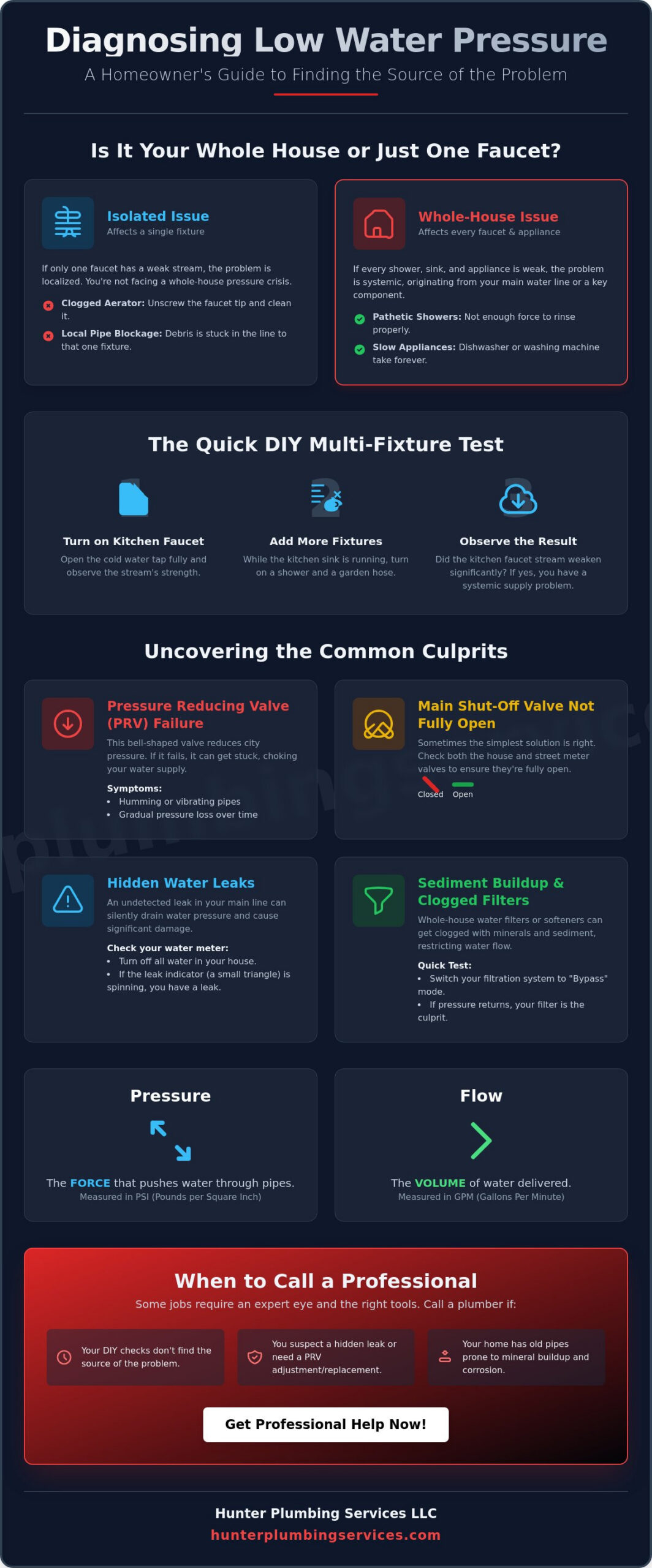
Before you start pulling apart pipes, you need to determine the scale of the problem. Whole-house low pressure means every fixture in your home is affected, from the upstairs shower to the garden hose in the backyard. If you only notice a weak stream at the kitchen sink, the issue is likely a clogged aerator or a localized pipe blockage. Diagnosing low water pressure in whole house requires a broader look at where your water enters the property and how it moves through your main lines.
Pay close attention to how the problem started. Did the water pressure vanish instantly, or has it been fading for months? A sudden drop often points to a major event, such as a burst main line or a city utility failure. A gradual decline is usually a sign of aging infrastructure. This slow fade often happens as mineral deposits constrict the inner diameter of your pipes or as a mechanical component, like a regulator, begins to wear out. Understanding this timeline helps us narrow down the list of suspects quickly.
Pressure vs. Flow: Understanding the Difference
Homeowners often use these terms interchangeably, but they describe two different things. Pressure is the force that pushes water through your pipes, while flow is the actual volume of water delivered. A professional tankless water heater installation must be sized correctly to maintain this balance. If the unit is too small for your household’s peak demands, you’ll experience a drop in volume when multiple taps run at once. Water flow rate is the volume of water passing through a fixture, measured in gallons per minute (GPM).
The Simple Multi-Fixture Test
You can perform a quick diagnostic test to see how your system handles demand. Follow these steps to check your home’s supply capacity:
- Turn on the kitchen cold water faucet and observe the stream.
- Open the shower valves and a garden hose simultaneously.
- Check if the kitchen faucet’s stream weakens significantly.
If the pressure drops sharply during this test, your home has a systemic supply problem. It’s also vital to check both hot and cold lines. If the cold water has plenty of muscle but the hot water is weak across the entire house, the issue is likely tied to your water heater rather than the main supply line. This simple check ensures you aren’t chasing a ghost in the wrong part of your plumbing system.
Common Culprits of Systemic Water Pressure Loss
Once you’ve confirmed the issue affects the entire property, it’s time to look at the mechanical components that regulate your supply. Diagnosing low water pressure in whole house often leads back to a few usual suspects. These range from simple valve adjustments to failing mechanical parts that protect your plumbing from high-pressure surges. Local municipal issues can also play a role. In the Myrtle Beach area, heavy seasonal demand or nearby water main breaks can cause a temporary drop in city-wide pressure. It’s always smart to check with your neighbors first. If everyone on the block is struggling with a weak shower, the problem is likely with the city’s supply lines rather than your home’s internal plumbing.
The Pressure Reducing Valve (PRV) Failure
The PRV is a bell-shaped brass fitting usually located near your main shut-off valve. Its job is to step down the high pressure from the city’s water main to a safe level for your home’s pipes. If this valve fails, it can stick in a partially closed position, choking off your supply. You might hear humming or vibrating sounds coming from your pipes when a PRV is on its way out. Don’t try to adjust the setting without a proper pressure gauge. Turning it blindly can lead to burst pipes or leaking fixtures.
Main Shut-off Valve and Meter Issues
Sometimes the solution is as simple as a handle that isn’t fully open. You have two main valves to check: the one at the street meter and the one where the line enters your house. If you recently had a repair, a technician might have left a valve slightly turned. Even a small restriction at the source can significantly reduce flow to the rest of the house. While you’re at the meter, look for a small red or silver triangle. This is a leak indicator. If it’s spinning while all your faucets are off, you likely have a hidden leak draining your pressure.
Sediment Buildup and Filtration Clogs
Many homeowners overlook their whole-house filtration systems or water softeners. These units are designed to catch sediment, but in areas with high mineral content, they can become “blinded” or fully clogged. If your filter is packed with grit, water can’t pass through efficiently. Try switching your system to “bypass” mode. If your pressure immediately returns to normal, you’ve found the problem. Over time, these same minerals can build up inside your actual plumbing lines. If you suspect your pipes are restricted, you may need a professional plumber for drain cleaning or line inspection to clear the path. If you’re feeling overwhelmed by these checks, our team can provide a quick diagnostic visit to restore your home’s comfort.
Step-by-Step Diagnostic Check for Homeowners
Solving a plumbing mystery requires a logical approach. When you’re diagnosing low water pressure in whole house, start by looking outside your property lines. Ask your neighbors if they’ve noticed a similar drop. If the entire street is affected, the city utility department is likely working on a water main break or performing hydrant maintenance. If you’re the only one on the block with a trickle, the issue is definitely localized to your home.
Next, walk out to your water meter and inspect the main shut-off valve. These valves are often located in a box near the curb or where the main line enters your home. Ensure the handle is turned completely to the “on” position. Even a quarter-turn toward the “off” position can choke the flow to your fixtures. If you’ve recently had work done on your street, utility workers may have left the valve partially closed. It’s a simple check that can save you a service call and restore your flow instantly.
How to Use a Water Pressure Gauge
The most accurate way to measure your system’s health is with a static pressure test. You can buy a simple water pressure gauge at most hardware stores for about $10. Screw the gauge onto an outdoor hose bib or the cold water faucet for your washing machine. Make sure all other faucets and appliances in the house are turned off during this test. A healthy residential system typically falls within the 40 to 60 PSI (pounds per square inch) range. If your reading is consistently below 30 PSI, you have confirmed a systemic supply issue that needs professional attention.
Checking for Major Leaks
A massive hidden leak can act like a siphon, stealing pressure before it ever reaches your showerhead. Walk your property and look for unusually soft spots in the soil or patches of grass that are much greener than the rest of the yard. Indoors, listen for the sound of running water behind walls when everything is turned off. If you suspect a problem but can’t find the source, you should request professional leak detection to protect your coastal home from structural damage. Our team uses specialized equipment to find underground breaks without digging up your entire yard. Don’t let a hidden break drive up your utility bill while ruining your home’s comfort. Contact us today for a thorough inspection of your main supply line.
Coastal Considerations and When to Call a Plumber
Living on the coast brings unique challenges that inland homeowners don’t have to face. Diagnosing low water pressure in whole house often requires looking at the environment as much as the hardware. Our local climate in Myrtle Beach is beautiful, but the salt air and high humidity are relentless on metal components. If your home’s infrastructure is older, these environmental factors might be the silent cause of your plumbing frustrations.
Our high water tables also play a role in your home’s plumbing health. Shifting sandy soil can put immense pressure on underground main lines. This movement can lead to hairline fractures or joint separations that siphons off your water pressure before it ever reaches your front door. Because these leaks happen deep underground, they often go unnoticed until your utility bill spikes or your pressure disappears entirely.
The Impact of Salt Air on Plumbing Hardware
Salt air accelerates the oxidation of brass and copper components, which are the primary materials in most valves. In coastal South Carolina, outdoor-mounted Pressure Reducing Valves (PRVs) tend to fail significantly faster than those installed in protected areas. The salt causes the internal springs to corrode and seize, which can lock the valve in a restricted position. If you notice your pressure drop is also affecting gas-powered appliances, it’s time to seek a licensed plumber for gas line services. Attempting to adjust high-pressure water systems or gas connections without professional training can lead to dangerous leaks or burst pipes.
What a Professional Diagnostic Includes
When you call in a professional, you’re getting more than just a visual check. A Hunter Plumbing service call involves a comprehensive system analysis to find the exact root of the problem. We use advanced tools that go beyond the capabilities of a standard home toolkit. Our process typically includes:
- Ultrasonic Leak Detection: We use sensitive microphones to hear the “hiss” of escaping water through concrete slabs or deep soil.
- Pipe Camera Inspections: Our technicians can see the internal condition of your main line to check for mineral scale or root intrusions.
- System-Wide Gauge Testing: We measure pressure at multiple points to isolate exactly where the drop occurs.
- Valve and PRV Inspection: We verify the mechanical integrity of your shut-offs and regulators to ensure they haven’t succumbed to coastal corrosion.
We provide 24/7 emergency availability for those moments when you experience a total and sudden loss of water. Our team is committed to providing financial clarity and dependable service to our neighbors. Don’t let a weak shower ruin your morning or a hidden leak damage your property’s foundation. Contact Hunter Plumbing Services LLC for a pressure diagnostic today and restore the comfort and efficiency of your home.
Restore Your Home’s Water Pressure Today
You don’t have to settle for weak showers or slow-filling appliances. Restoring your home’s comfort starts with a clear understanding of your plumbing system’s health. Whether the issue is a failing pressure reducing valve or a hidden leak caused by shifting coastal soil, diagnosing low water pressure in whole house is a process of elimination that you can start today. By checking your main shut-off valves and performing a simple gauge test, you can quickly determine if the fix is a simple adjustment or requires a professional’s specialized tools.
As a family owned and operated business in Horry County, we understand how salt air and high water tables impact our neighbors’ plumbing. We bring specialized coastal plumbing expertise to every service call to ensure your property remains in safe, capable hands. If your pressure has vanished suddenly, we provide 24/7 emergency assistance to get your household back on track. Schedule Your Whole-House Pressure Diagnostic in Myrtle Beach to find a long-lasting solution. We are here to help you regain peace of mind and full efficiency in your home.
Frequently Asked Questions
Is low water pressure a plumbing emergency?
A total loss of water pressure is a plumbing emergency because it halts essential sanitation and daily routines. If your faucets stop flowing entirely, it often signals a major break in the main line or a failure at the street. In these situations, your property could be at risk for water damage. You should seek professional help immediately to prevent structural issues or high utility bills.
Can a failing water heater cause low pressure in the whole house?
A failing water heater typically only affects the pressure on the hot water side of your plumbing system. Since the cold water bypasses the heater, it should maintain full strength even if the heater is clogged with sediment. If you notice a drop across both hot and cold lines, the root cause is likely further upstream in your main supply line or the pressure regulator.
How do I know if my water pressure regulator is bad?
You can tell your pressure regulator is failing if you hear vibrating or humming noises coming from your pipes. A bad regulator often causes the water pressure to fluctuate or drop significantly across every fixture. When diagnosing low water pressure in whole house, we often find that these bell-shaped valves have seized due to age or coastal corrosion. Replacing a worn regulator is a standard way to restore consistent, safe pressure.
Why is my water pressure low only on the hot water side?
Low pressure limited to the hot water side usually points to sediment buildup inside your water heater tank or a partially closed shut-off valve on the unit. Over time, minerals settle at the bottom of the tank and can block the outlet pipe. Flushing the tank or checking the heat trap nipples can often restore the flow without needing a full replacement of the system.
Does a whole-house water filter reduce water pressure?
A whole-house water filter can definitely reduce your pressure if the internal cartridge is dirty or undersized for your household. These systems trap sediment and minerals, which eventually restrict the path of the water. If you haven’t changed your filter recently, try bypassing the unit to see if the pressure returns. Keeping up with regular maintenance ensures your filtration system doesn’t become a bottleneck for your home’s supply.
What should I do if my neighbor has low water pressure too?
You should contact your local water utility department if your neighbors are struggling with the same pressure issues. This shared problem indicates a neighborhood-wide event such as a water main break or city maintenance work. Since the cause is on the city’s side of the meter, they are responsible for the repair. Calling them first can save you the cost of a private service visit for a problem you can’t fix yourself.