
Last Wednesday, a homeowner in the Forestbrook neighborhood discovered that their dishwasher was taking over 95 minutes just to complete a basic fill cycle. It’s a common frustration here in Myrtle Beach. Weak flow can turn a quick morning shower into a long, annoying ordeal. You shouldn’t have to wonder if your soap will ever rinse off or worry that you need a professional plumber for low water pressure because of a hidden slab leak. We believe your home should be a place of comfort, not a source of constant stress.
This article will help you identify the root cause of your flow issues. You’ll learn how to spot the difference between a simple DIY fix and a serious pipe failure. We’ll explain why local water conditions affect your fixtures and how to restore strong, consistent flow to every tap. We’ll also break down the signs of aging pipes so you can decide if a professional repair is the most cost-effective path forward for your family. It’s time to get your plumbing back on track.
Key Takeaways
- Understand how Myrtle Beach’s peak tourist seasons and coastal salt air contribute to common residential water pressure issues.
- Learn to distinguish between a sudden pressure drop and a gradual decline to catch hidden leaks before they become emergencies.
- Identify simple DIY troubleshooting steps and know exactly when to call a professional plumber for low water pressure to protect your home.
- Discover how advanced diagnostics, such as camera inspections, can uncover salt-air corrosion and pipe obstructions deep in your system.
- Determine if your home falls below the standard 40 PSI threshold and learn the professional steps required to restore consistent water flow.
Why is My Water Pressure Low in Myrtle Beach?
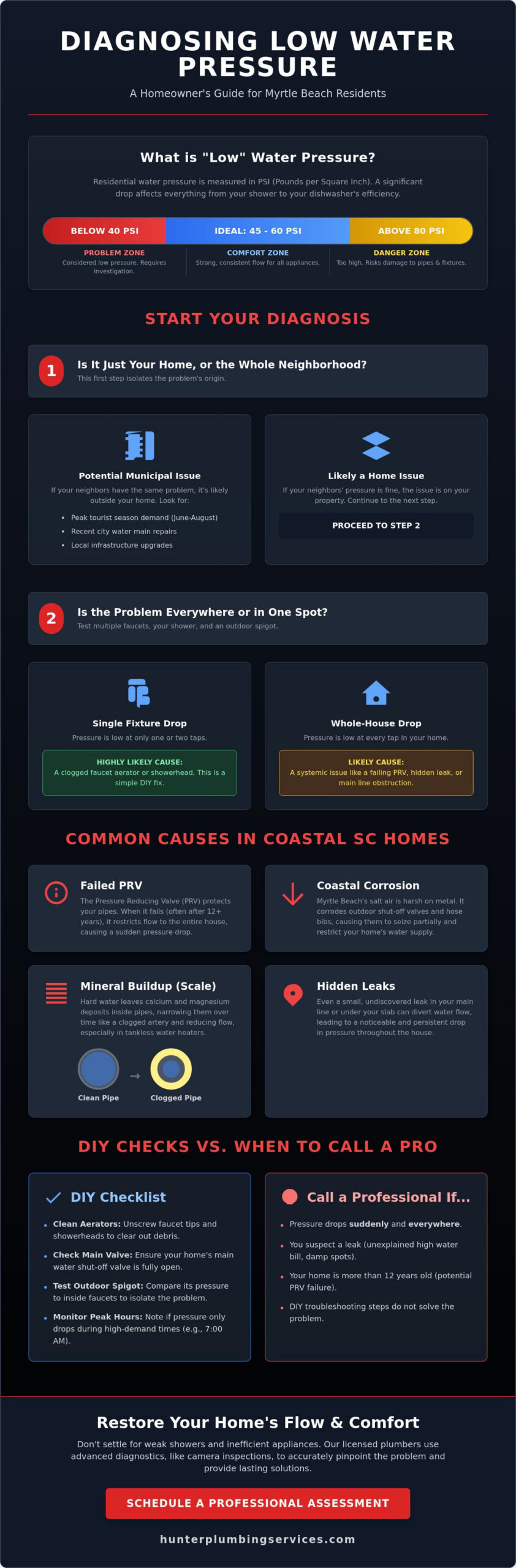
There is nothing more frustrating than stepping into the shower only to meet a weak trickle of water. In coastal South Carolina, we see this issue frequently. Residential water pressure should ideally sit between 45 and 60 PSI. If your home registers below 40 PSI, it is officially considered low. This is not just an inconvenience. It affects your dishwasher’s efficiency and extends your laundry cycles. Finding a reliable plumber for low water pressure is the first step toward restoring your home’s comfort and functionality.
Myrtle Beach faces unique challenges due to our seasonal population shifts. During peak tourist months from June to August, the local population often swells by over 100,000 visitors. This massive surge puts a heavy load on the municipal water supply system. You might notice your pressure dips specifically when the hotels are at full capacity. It’s vital to identify if the issue affects every tap or just one sink. A single-fixture problem usually means a clogged aerator, while a whole-house drop points to a deeper systemic issue that requires professional attention.
Myrtle Beach Municipal vs. Private Well Issues
Horry County frequently conducts water main repairs or infrastructure upgrades to keep up with rapid regional growth. These projects can cause temporary pressure drops lasting 24 to 48 hours. If your neighbors are also experiencing weak flow, the issue likely lies with the city supply. For homeowners in marshfront areas, high water tables often sit just 3 feet below the surface. This constant moisture can corrode well pump components or lead to pressure switch failures. We provide honest assessments to determine if the fault lies with your equipment or the local grid.
The Role of the Water Pressure Regulator (PRV)
Most modern homes in Myrtle Beach are equipped with a Pressure Reducing Valve (PRV). This bell-shaped brass component protects your pipes from high-pressure surges that can cause leaks. When a PRV fails, it often defaults to a restricted position. This results in a sudden, significant loss of pressure throughout the entire house. The PRV is the gatekeeper of your home’s plumbing health. If your home is more than 12 years old, your regulator may be nearing the end of its functional life. If you notice a sudden drop, calling a plumber for low water pressure ensures a safe and transparent replacement process.
- Check your neighbors: See if the problem is localized to your property.
- Test the outdoor spigot: This helps determine if the issue is inside or outside the home.
- Monitor peak hours: Note if pressure drops during high-demand times like 7:00 AM.
Our family-owned team at Hunter Plumbing Services is here to help you navigate these frustrations. We focus on long-lasting solutions rather than quick fixes. We believe in providing peace of mind through technical expertise and neighborly service.
Common Causes of Low Water Pressure in Coastal SC Homes
Living in the Grand Strand means dealing with unique environmental factors that don’t affect inland properties. Your home’s plumbing faces constant pressure from the Atlantic’s salt air and the high mineral content found in our local groundwater. When you need a plumber for low water pressure, it’s often because one of these hidden forces has been working against your pipes for months. Identifying the specific culprit is the first step toward restoring your home’s flow.
Coastal Corrosion and Mineral Buildup
Salt air is a silent enemy for coastal plumbing. It accelerates oxidation on exposed metal surfaces, particularly your outdoor hose bibs and the main shut-off valve. If these valves corrode, they can partially seize or restrict flow without you even noticing. Myrtle Beach homes also frequently use tankless water heaters. These units are incredibly efficient, but they’re highly susceptible to calcium and magnesium buildup. Over 85% of homes in the United States deal with hard water, and our coastal region sees significant mineral concentrations. This scale narrows the internal diameter of your pipes, much like a clogged artery. You can prevent this long-term damage by investing in whole house filtration to catch minerals before they settle in your heat exchanger.
Clogged Fixtures and Aerators
Sometimes the problem is right at the finish line. Showerheads and faucet aerators act as filters for small debris. If you notice a drop in pressure at only one sink, it’s likely a localized clog rather than a whole-house issue. We often see the “sand in the line” phenomenon after the city performs water main repairs or during periods of heavy local construction. This sediment can rush into your home’s system, instantly clogging fine mesh screens. Beyond the annoyance of a weak shower, it’s important to understand the dangers of low water pressure, as it can sometimes allow contaminants to enter the lines through back-siphonage if the pressure drop is severe enough. The same salt-air corrosion that degrades residential fixtures affects local businesses even more severely due to higher usage demands, which is why many Grand Strand property owners also search for commercial plumbing near me to address high-usage system failures before they impact revenue.
Newer developments in Myrtle Beach aren’t immune to these issues. Rapid growth in areas like Carolina Forest has occasionally led to “solar cowboys” or unlicensed contractors performing rushed installations. We’ve found pressure-reducing valves (PRVs) installed backwards or undersized piping in homes built as recently as 2022. Common culprits we identify include:
- Corroded main shut-off valves from salt air exposure.
- Mineral scale narrowing the path inside copper or PEX lines.
- Sediment spikes after municipal utility work.
- Incorrectly adjusted or failing Pressure Reducing Valves (PRV).
If your neighbors have great pressure but you don’t, it’s time to have an expert inspect your main line. A qualified plumber for low water pressure can quickly determine if the fault lies in a single fixture or a systemic installation error that requires a professional fix.
Sudden vs. Gradual Pressure Drops: Diagnosing the Source
The speed at which your water flow changes tells a specific story about your plumbing system. Identifying whether the change was instant or happened over several months helps you decide how quickly you need to contact a plumber for low water pressure. A sudden loss of pressure is often a red flag for a plumbing emergency, while a slow decline suggests a maintenance issue that’s finally reached a breaking point.
Use this simple framework to gauge the severity of your situation:
- If pressure dropped instantly: Check your yard for standing water or your crawlspace for flooding. This often indicates a burst pipe or a failed pressure reducing valve.
- If pressure is low only at one fixture: The problem is likely a clogged aerator or a localized pipe blockage.
- If pressure has faded over 6 to 12 months: You’re likely dealing with mineral scale buildup or aging galvanized pipes that are narrowing internally.
- If pressure fluctuates throughout the day: This may be related to peak usage times in your Myrtle Beach neighborhood or a failing well pump if you aren’t on city water.
Is It a Hidden Leak?
A hidden leak can waste hundreds of gallons of water before you even notice a damp spot. You can perform a simple 2-hour test using your water meter to confirm your suspicions. First, turn off every faucet, showerhead, and water-using appliance in your home. Locate your water meter and write down the current reading. Wait exactly 120 minutes without using any water, then check the meter again. If the numbers have changed, water is escaping somewhere in your system.
In Myrtle Beach, many homes are built on concrete slabs. Signs of a slab leak include unexplained warm spots on your floor tiles or dampness along the bottom of your drywall. While the meter test confirms a leak exists, professional leak detection is the only way to pinpoint the exact location without unnecessarily tearing up your flooring. If you also notice a persistent pool of water forming near your toilet base, you may want to investigate why your toilet is leaking from the bottom, as a failing wax ring can mimic the signs of a slab leak in coastal homes with high humidity.
Water Heater Performance and Pressure
If you notice that your cold water flow is strong but your hot water has turned into a weak trickle, the issue lies within your water heating system. In traditional tank heaters, sediment from our local water supply settles at the bottom of the tank over 5 to 10 years. This debris eventually blocks the hot water outlet, significantly reducing the pressure you feel in the shower.
Tankless units face a different challenge. Calcium and magnesium deposits can coat the narrow passages of the heat exchanger. When this happens, the unit throttles the flow to ensure the water reaches the set temperature. If your tankless system hasn’t been descaled in the last 12 months, this is likely why your pressure has vanished. A professional plumber for low water pressure can flush these systems to restore your home’s original flow rate.
DIY Troubleshooting vs. When to Call a Professional Plumber
Before you reach for the toolbox, take a quick walk outside. If your neighbors on your Myrtle Beach street are also experiencing weak flow, the problem likely stems from a municipal water main break or city-wide maintenance. However, if the issue is isolated to your home, you can perform a few safe checks. Knowing when to handle it yourself and when to call a plumber for low water pressure can save you hundreds in unnecessary repair costs.
The 3-Step DIY Pressure Check
You don’t need specialized training for these basic maintenance tasks. Start with these three steps to see if the fix is simpler than it looks:
- Step 1: Clean your fixtures. Mineral deposits from the local water supply often clog faucet aerators and showerheads. Unscrew the tip of your faucet and soak the mesh screen in white vinegar for 12 hours to dissolve buildup. This simple step can restore flow in 85% of localized pressure cases.
- Step 2: Inspect the main shut-off valve. This valve is frequently located in the garage or a utility closet. Ensure it’s turned completely to the open position. A valve that’s even 25% closed can significantly throttle your home’s water volume.
- Step 3: Check your PRV if you have a gauge. Use a standard $12 pressure gauge on an outdoor spigot. If the reading is consistently below 40 PSI, your Pressure Reducing Valve might be failing.
When DIY Isn’t Enough
There’s a thin line between a quick fix and a plumbing disaster. Never attempt to adjust your PRV blindly. Increasing the pressure too much can cause your water heater to leak or pipes to burst under the stress of high velocity. Our team has seen DIY attempts lead to 50-gallon floods because a homeowner didn’t have the right calibration tools. Additionally, stay away from chemical cleaners. These harsh liquids won’t fix pressure issues and can corrode your pipes from the inside out in less than 30 minutes.
If you see water pooling near your foundation or hear water running when all faucets are off, don’t wait. You should contact emergency plumbing services immediately to mitigate structural damage. For any major component replacements or underground leak detection, hiring a licensed plumber in Conway, SC ensures the work is bonded, insured, and compliant with local safety standards. A professional plumber for low water pressure has the diagnostic equipment to find the root cause without any guesswork.
Ready to restore your home’s water flow? Schedule your inspection with Hunter Plumbing Services for an honest, transparent solution.
Professional Low Pressure Solutions for the Grand Strand
When you call a plumber for low water pressure, you deserve a solution that lasts. Hunter Plumbing Services approaches every call with a focus on accuracy and transparency. We know that weak flow in the shower isn’t just a nuisance; it often signals a larger issue hidden underground or behind your walls. Our technicians combine years of local experience with modern technology to pinpoint the exact source of your trouble. As a family-owned business, we value the trust our neighbors place in us. That’s why we always provide upfront pricing before any work begins. You’ll know exactly what the job entails and what it costs before we ever pick up a wrench.
Advanced Diagnostic Tools
Finding the root cause of weak flow requires more than a quick glance at a faucet. Our team uses electronic leak detection to find hissing pipes that are tucked away behind your drywall or under concrete slabs. This specialized equipment allows us to hear leaks that are too small to see but large enough to drop your home’s PSI significantly. For many older Myrtle Beach properties built in the 1970s and 1980s, we use high-definition camera services. These waterproof cameras travel deep into your plumbing to reveal pipe corrosion, heavy mineral buildup, or root intrusion from local oak trees. This level of detail ensures we fix the right problem the first time. You’ll avoid the high costs of unnecessary parts and the frustration of guess-and-check plumbing.
Restoring Your Home’s Flow
Restoring your water pressure involves several different strategies depending on our diagnostic findings. If mineral-clogged lines are the culprit, we often recommend hydro-jetting. This method uses high-pressure water to blast away years of scale and debris. It’s an efficient way to clear your pipes without using corrosive chemicals that can damage older plumbing materials. For homes with failing hardware, we handle PRV replacement and system recalibration to keep your pressure within the safe, standard range. If your pipes have reached the end of their lifespan due to age and salt-air exposure, a partial repipe might be the smartest investment. We focus on providing the most cost-effective path to long-term reliability and peace of mind. Business owners facing similar coastal pipe degradation issues in their hotels, restaurants, or retail spaces can find specialized guidance by exploring our commercial plumbing solutions for Myrtle Beach businesses. Contact Hunter Plumbing Services for a professional pressure evaluation today.
Restore Your Grand Strand Water Pressure Today
Living along the South Carolina coast brings unique challenges to your home’s plumbing system. You now know that low pressure isn’t just an annoyance; it’s often a symptom of coastal corrosion or hidden pipe leaks that require immediate attention. Since 2021, Hunter Plumbing Services has operated as a locally owned family business dedicated to solving these specific regional issues. We focus on specialized leak detection and salt-related pipe degradation to keep your water flowing correctly. You don’t have to guess whether your pressure drop is a simple fix or a major emergency. Hiring a professional plumber for low water pressure ensures that your pipes get a thorough diagnostic using modern technology. Our team remains available for 24/7 emergency service across the Grand Strand, providing the peace of mind you deserve. We pride ourselves on transparent communication and dependable workmanship for every neighbor we serve. Take the first step toward better water flow and protect your property from long-term damage.
Schedule a Professional Water Pressure Diagnostic with Hunter Plumbing Services
Your home is in good hands with experts who treat your family like their own.
Frequently Asked Questions
Is low water pressure a plumbing emergency?
Low water pressure is typically a convenience issue rather than an emergency, but it becomes critical if it results from a major pipe burst. If your pressure drops to zero instantly, you should turn off your main water valve to prevent structural damage. A sudden 50% drop often indicates a hidden leak that can waste 10,000 gallons of water in 30 days. Contact a plumber for low water pressure if you notice damp spots on your drywall or foundation.
Can a clogged drain cause low water pressure?
No, a clogged drain won’t cause low water pressure because your supply lines and drainage pipes operate as separate systems. Water pressure issues occur in the pipes bringing fresh water into your home, while clogs happen in the pipes carrying waste away. If you experience both problems simultaneously, you likely have two distinct plumbing issues or a failing pressure regulator. Our family-owned team can inspect both systems to ensure your home runs efficiently and reliably.
How much does a plumber charge to fix low water pressure in Myrtle Beach?
Costs for these repairs depend on the specific cause, such as a failing pressure reducing valve or a corroded main line. HomeAdvisor reports that national averages for general plumbing repairs range from $180 to $490 per visit. We provide upfront pricing after a physical inspection so you know exactly what to expect before work begins. This transparency ensures you get the best value for your Myrtle Beach home without any hidden fees or surprises.
What is the ideal water pressure for a home in Horry County?
The ideal water pressure for a home in Horry County is between 40 and 60 pounds per square inch (PSI). According to the Uniform Plumbing Code, pressure shouldn’t exceed 80 PSI, as excessive force can damage your appliances and cause pipe joints to fail. You can test your own pressure with a $15 gauge from a local hardware store. If your reading is below 30 PSI, your fixtures won’t function with the power you expect.
Why is my water pressure low in only one bathroom?
Low pressure in a single bathroom usually points to a localized issue like a clogged aerator or a failing showerhead cartridge. Mineral deposits from the local water supply can block the small screens in your faucets over 3 to 5 years of use. If the low pressure only affects your hot water, the problem might be sediment buildup in the lines leading from your tank. Cleaning these fixtures or replacing the cartridge often restores your flow immediately.
Can a faulty water heater affect my whole house’s water pressure?
A faulty water heater can affect your hot water pressure across the entire house if sediment blocks the outlet valve. Over a 10 year lifespan, 2 or 3 inches of mineral scale can accumulate at the bottom of a traditional tank. This buildup restricts the flow of water as it exits the heater and enters your pipes. If your cold water pressure is fine but the hot water is weak, a plumber for low water pressure should flush your tank.
What happens if I ignore low water pressure for too long?
Ignoring low water pressure can lead to expensive appliance failures and hidden structural damage. Dishwashers and washing machines require specific flow rates to cycle correctly, and low pressure can double their cycle times. This issue often signals a small leak that can eventually lead to a 30% increase in your monthly utility costs. Addressing these signs early prevents the 2,000 gallons of monthly waste typical of a single pinhole leak in your plumbing.
Does the city of Myrtle Beach provide assistance for low pressure issues?
The City of Myrtle Beach Public Works Department will investigate if the low pressure originates from the city’s main line or your water meter. If the issue is on your side of the meter, the city won’t perform repairs on your private plumbing system. You can call the city dispatch line at 843-918-2000 to report a neighborhood wide outage. For issues inside your property line, our local team provides the necessary professional repairs and honest advice.