

Last Tuesday, a homeowner in The Market Common discovered a persistent pool of water on their bathroom floor that wouldn’t go away. If you find yourself in a similar spot, you’re likely asking, “why is my toilet leaking from the bottom?” while worrying about potential subfloor rot in your marshfront home. In our Myrtle Beach climate, where humidity often exceeds 80 percent, even a small drip can lead to visible mold growth within just 24 to 48 hours.
We know how unsettling it is to deal with mystery moisture or foul sewage odors in your private space. You want an honest solution that protects your property and your family’s health. This guide will help you pinpoint the exact source of the leak and determine if it’s a simple fix or a job for a professional plumber. We’ll walk through the most common culprits, from loose mounting bolts to failing wax rings, so you can restore your peace of mind and keep your bathroom floor dry and safe.
Key Takeaways
- Distinguish between a mechanical leak and environmental “sweating” caused by high Myrtle Beach humidity levels.
- Identify common culprits like failed wax rings or corroded bolts to understand why is my toilet leaking from the bottom.
- Learn simple diagnostic methods like the dye test to pinpoint the exact source of a bathroom floor puddle.
- Determine when a quick bolt adjustment is enough and when you need a professional for a messy wax ring replacement.
- Protect your coastal home by choosing hardware that resists salt air to prevent long-term water damage and mold.
Is Your Myrtle Beach Toilet Leaking or Just “Sweating” in the Humidity?
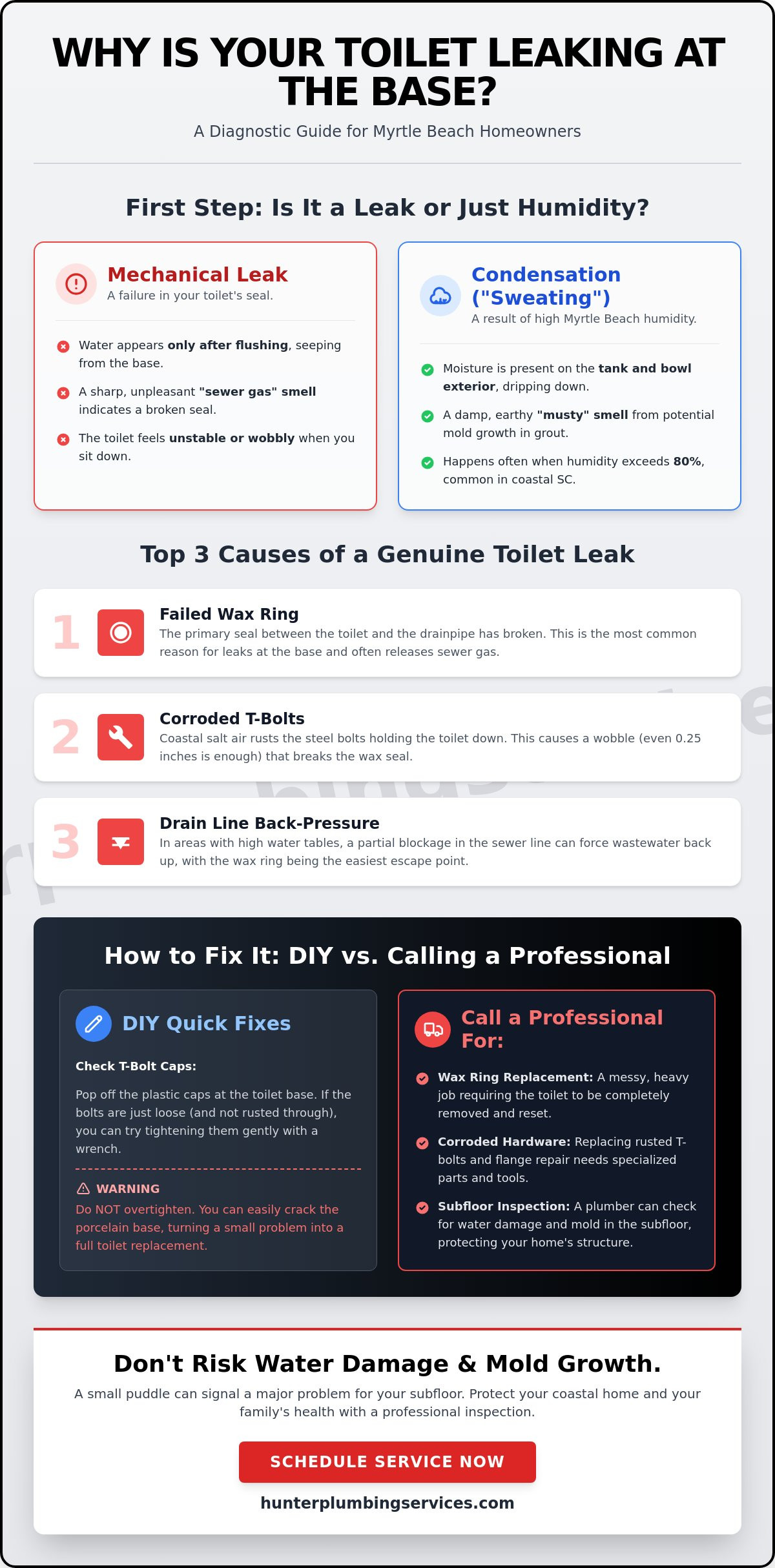
Living on the Grand Strand means dealing with high humidity levels that often climb above 80 percent during the summer months. This moisture doesn’t just affect your comfort outdoors; it changes how your bathroom fixtures behave. If you notice a puddle around the base of your fixture, you might immediately wonder why is my toilet leaking from the bottom. Before you panic, it’s vital to distinguish between a mechanical failure and environmental condensation, often called “sweating.”
Condensation occurs when the cold water inside your tank or bowl cools the porcelain surface. When the warm, humid Myrtle Beach air hits that cold porcelain, it turns into liquid droplets. This water eventually drips down and pools on the floor. While this isn’t a mechanical leak, it’s still a problem. Misdiagnosing the issue can lead to two extremes: you might ignore a serious structural leak thinking it’s just humidity, or you might spend money replacing a perfectly good wax ring. To understand the difference, it helps to know how a toilet works and where the water is stored before you start pulling things apart.
The Paper Towel Test for Condensation
You can identify the source of the water with a simple, low-cost test. Follow these steps to see if the air or the plumbing is the culprit:
- Dry the entire exterior of the toilet and the floor around the base using a clean towel.
- Wait about 15 to 20 minutes without flushing the toilet.
- Take a fresh, dry paper towel and wipe it along the underside of the tank and the back of the bowl.
- Check if the moisture starts at the top and drips down, or if it only appears at the very bottom where the porcelain meets the floor.
If the paper towel gets wet near the top or middle of the porcelain, you’re likely dealing with condensation. If the porcelain stays dry but water seeps out from under the base after a flush, you have a genuine mechanical leak.
Signs of Coastal Mold Growth
In Horry County, even “sweating” is a serious concern because it creates a breeding ground for fungi. When moisture sits at the base of your toilet, it soaks into the grout and subfloor. You can usually tell the difference by the scent. A mechanical leak involving the wax ring often produces a sharp, sulfurous “sewer” smell because the seal that keeps gases out is broken. Condensation, however, leads to a damp, earthy “musty” smell characteristic of mold. In coastal South Carolina bathrooms, black mold can colonize the porous grout around a toilet base within 48 to 72 hours of exposure to consistent moisture. Don’t let a small puddle turn into a health hazard for your family.
5 Common Reasons for a Toilet Leaking from the Bottom in Horry County
Finding a puddle on your bathroom floor is a stressful discovery for any homeowner. If you’re asking why is my toilet leaking from the bottom, the answer usually starts with a failure of the internal seal. Every time you flush, gallons of water move through the base. When components fail, that water has nowhere to go but onto your tile or into your subfloor. Diagnosing the specific cause early can save you from expensive floor replacements and structural repairs.
Salt Air and Corroded T-Bolts
Living within 5 miles of the coast means your home’s hardware is constantly exposed to salt-heavy air. This environment accelerates the oxidation of standard steel mounting bolts, often called T-bolts. These bolts hold your toilet firmly to the floor flange. When they rust and thin out, the toilet begins to wobble. Even a tiny shift of 0.25 inches is enough to snap the internal seal. If you notice your toilet feels unstable when you sit down, your hardware has likely failed. We recommend replacing rusted bolts with solid brass or stainless steel alternatives that can withstand the Myrtle Beach humidity. The same salt air that degrades residential hardware is an even greater concern for high-traffic facilities; businesses facing this issue can learn more about commercial plumbing near me solutions built for coastal resilience.
The Impact of High Water Tables on Drainage
In Horry County, many marshfront properties sit on high water tables. During periods of heavy rain or high tide, local drainage systems often face significant back-pressure. If your sewer line has a partial blockage, this pressure forces wastewater toward the easiest exit. Often, that exit is the wax ring at the base of your commode. A slow drain that occasionally gurgles is a sign that pressure is building up. Addressing these deep-line issues requires professional leak detection to confirm if the problem is your toilet or a larger main line obstruction.
The wax ring remains the most frequent culprit when homeowners wonder why is my toilet leaking from the bottom. These rings are designed to last 10 to 15 years, but frequent plunging or a loose toilet can ruin them much sooner. Once the wax is compressed or shifted, it cannot regain its shape. This leads to a slow, consistent leak that might go unnoticed until the floor begins to soften or discolor. Catching this early is vital for preventing water damage and mold from taking hold in your bathroom’s foundation.
Other common causes include:
- A Cracked Toilet Flange: This is the pipe fitting that connects the toilet to the sewer line. If the flange is cracked or installed too low, the wax ring won’t sit properly.
- Hairline Porcelain Cracks: Sometimes the leak isn’t a seal issue at all. Small cracks in the base of the porcelain bowl, often caused by overtightening bolts during installation, can weep water slowly over time.
- Sewer Line Backups: A clog deep in your pipes can cause water to back up and seep out from the base during a flush or when other appliances are running.
If you suspect a hidden leak is damaging your home, our team can help. You can reach out to a local expert at Hunter Plumbing Services to get a clear, honest assessment of your bathroom’s health.
Step-by-Step: How to Diagnose the Source of Your Bathroom Floor Puddle
Finding water around the base of your fixture is a stressful discovery for any Myrtle Beach homeowner. You need to determine why is my toilet leaking from the bottom before you can apply a permanent fix. Start your diagnosis by drying the entire area with a towel. Once the floor is bone dry, perform a visual inspection of the supply line and the silver shut-off valve located behind the bowl. Condensation or a slow drip from these connections often trickles down the porcelain, pooling at the base and mimicking a more serious seal failure.
After checking the supply line, perform a “rocking test” to check the unit’s stability. Place your hands on the sides of the bowl and gently try to move it from side to side. A properly installed toilet shouldn’t budge. If the fixture wobbles even 1/4 inch, the wax ring seal underneath has likely broken. This wax seal is a one-time-use component. Once the bond between the toilet and the floor is interrupted by movement, water will escape onto your subfloor every time you flush.
Identify the frequency of the leak to narrow down the culprit. Watch the floor closely during a test flush. If the puddle grows immediately after the flush, the wax ring is the primary suspect. However, if the floor stays wet even when you haven’t used the bathroom for 6 hours, you’re likely dealing with a constant supply-side leak or a hairline crack in the tank. Identifying this pattern helps you communicate clearly with your plumber and ensures a faster repair.
Using the Dye Test
The dye test is a reliable way to rule out internal tank leaks that might be dripping down the back of the bowl. Remove the tank lid and add 10 to 15 drops of dark food coloring, such as blue or green, into the water. Don’t flush the toilet. Wait exactly 20 minutes and check the water pooling on the floor. If the puddle turns the color of your dye, the leak is coming from the tank-to-bowl gasket or the mounting bolts rather than the floor seal. This simple diagnostic step prevents you from unnecessarily pulling up the entire fixture.
Inspecting the Closet Flange
The closet flange is the circular fitting that secures your toilet to the floor and connects it to the sewer pipe. It should sit exactly level with your finished flooring. If the flange is too low, perhaps due to a recent tile-over-tile renovation, the wax ring won’t create a deep enough seal to prevent leaks. If the flange is too high, the toilet will never sit flush, causing it to rock and break the seal. Because a broken or corroded flange involves the main drainage line, this specific repair requires a professional plumber to prevent structural rot and sewer gas leaks.
Fixing the Leak: DIY Minor Adjustments vs. Calling a Myrtle Beach Plumber
When you discover water pooling on your bathroom floor, you need to determine why is my toilet leaking from the bottom before the damage spreads to your subfloor. In many cases, the fix is a simple adjustment you can handle in ten minutes. Other times, the problem involves a degraded seal or a broken flange that requires professional equipment. Understanding the limits of a DIY approach will save you from accidental floor damage or a cracked toilet bowl.
DIY: Tightening the Mounting Bolts
If the leak is small, the mounting bolts might have vibrated loose over time. Start by removing the plastic caps at the base of the toilet. Use a flathead screwdriver to gently pry them up. Don’t force them; these caps become brittle and can snap easily. Once the bolts are exposed, use an adjustable wrench to tighten the nuts. Follow the “snug but not tight” rule. If you over-tighten, you risk cracking the porcelain, which turns a cheap fix into an expensive replacement. If the bolt spins freely without tightening, the mounting flange underneath is likely broken.
The Reality of Replacing a Wax Ring
If tightening the bolts doesn’t work, the wax ring has likely failed. This is a common issue in Myrtle Beach homes where high humidity can affect bathroom fixtures. To fix this yourself, you will need:
- A new wax ring (reinforced with a plastic horn is often better)
- New brass T-bolts
- An adjustable wrench and a bucket
- A putty knife to scrape away the old, sticky wax
This is a messy, labor-intensive job. You must drain the tank completely, disconnect the supply line, and lift the entire toilet off the floor. If you feel the toilet is too heavy or if you notice the floor feels soft or spongy, stop immediately. Soft wood indicates that the leak has been active for a long time, potentially rotting the joists. Before attempting this repair, it’s worth understanding how much a plumber charges to replace a toilet in 2026 so you can weigh the true cost of DIY versus professional service.
When to Call Hunter Plumbing Services
There are specific signs that a professional should take over. If you find a cracked flange or if the toilet continues to wobble after a new ring is installed, a local expert is needed. Interestingly, a plumber for low water pressure can often identify if your base leak is tied to larger systemic issues in your home. Older Grand Strand homes often have cast iron or lead pipes that require specialized repair techniques that go beyond a simple wax ring swap.
At Hunter Plumbing Services, we provide upfront pricing and a neighborly approach to every repair. We ensure the flange is level and the seal is airtight, giving you peace of mind that your floor is protected. If you are tired of wondering why is my toilet leaking from the bottom, let our team provide a permanent solution.
Don’t risk water damage to your bathroom floor. Contact Hunter Plumbing Services today for a professional toilet reset and inspection.
Preventing Water Damage and Mold in Your Coastal SC Home
Living near the Atlantic Ocean means your plumbing faces unique challenges that inland homes don’t encounter. Salt air accelerates corrosion on metal components, often leading to premature failure of your bathroom fixtures. You should swap out standard steel bolts for stainless steel or brass hardware. These materials resist the pitting and rust caused by salt spray. This small upgrade prevents hardware failure, which is a common reason why is my toilet leaking from the bottom in coastal regions. It ensures that when you eventually need to pull the toilet for repairs, the bolts won’t snap or seize.
Humidity is another major factor in Myrtle Beach. When indoor humidity levels climb above 60 percent, you might notice your toilet tank “sweating.” This condensation drips down the side of the porcelain and pools at the base, mimicking an actual leak. Installing a dedicated bathroom dehumidifier or upgrading your exhaust fan can reduce this moisture. Keeping your bathroom air dry protects your flooring and prevents mold spores from taking root in your grout lines.
The Right Way to Caulk a Toilet
Many homeowners think a full bead of caulk around the base is the best practice for a clean look. This is a mistake that can lead to expensive repairs. If you seal the entire perimeter, you hide the answer to why is my toilet leaking from the bottom until the damage is severe. Trapped water from a failed wax ring will rot your subfloor and grow black mold before you ever see a puddle. Always leave a one-inch gap, often called a weep hole, at the very back of the toilet base. This gap allows leaking water to escape onto the floor where you can see it immediately. Use a 100 percent silicone caulk with built-in antimicrobial properties to handle the high-moisture environment of a coastal bathroom.
Long-term Protection for Myrtle Beach Homes
Coastal South Carolina often deals with hard water levels exceeding 120 mg/L. These minerals degrade the rubber seals and wax rings that keep your bathroom dry. Installing a whole-house water filtration system can extend the life of these internal components by 30 percent or more. This prevents the rubber from becoming brittle and cracking over time. Scheduling professional maintenance is the most reliable way to catch small drips before they become floods. If you’re looking for expert guidance on your home’s health, hiring a plumber in Conway, SC for an annual plumbing audit ensures your home stays protected year-round.
Follow this dry-floor checklist to maintain your bathroom:
- Inspect supply line hoses for cracks or stiffening every 6 months.
- Check for soft spots or discoloration in the flooring around the toilet base.
- Ensure the toilet doesn’t rock or move when you sit down.
- Monitor indoor humidity to keep it consistently below 50 percent.
- Schedule an annual inspection to check the integrity of all wax seals.
Taking these proactive steps keeps your home safe from the silent damage caused by hidden leaks. A little bit of prevention today saves you from the stress of a major restoration project tomorrow. Property owners managing multiple bathrooms in a rental or hospitality setting should also explore commercial plumbing near me services designed for high-usage Myrtle Beach properties to keep every fixture performing reliably.
Protect Your Myrtle Beach Home From Costly Water Damage
Understanding why is my toilet leaking from the bottom is the first step toward protecting your bathroom floor and subfloor. In our humid Horry County climate, even a small puddle can lead to significant mold growth within 24 to 48 hours according to FEMA guidelines. Whether your wax ring has failed or the coastal salt air has corroded your closet bolts, ignoring the moisture only invites structural decay. You don’t have to tackle these specialized coastal plumbing challenges alone. Hunter Plumbing Services provides 24/7 emergency service in Myrtle Beach to ensure your home stays dry and safe. We believe in upfront, transparent pricing so you know exactly what to expect before we start the work. Our team treats your house like our own, bringing local expertise and a neighborly touch to every repair. Don’t let a minor leak turn into a major restoration project. We are ready to help you restore your peace of mind with reliable, professional service that stands the test of time. Stop the leak before it ruins your floor; contact Hunter Plumbing Services today!
Your home is your biggest investment, and we’re here to help you keep it in top shape. Give us a call today to get your plumbing back on track and your bathroom floor dry again.
Frequently Asked Questions
Is it an emergency if my toilet is leaking from the bottom?
Yes, a toilet leaking from the base is a plumbing emergency that requires immediate attention. Water seeping into your floorboards can lead to structural rot within 48 hours of the first leak. This moisture also creates a breeding ground for mold in our humid South Carolina climate. If you see water pooling, turn off the shut-off valve behind the toilet right away to protect your home from further damage.
Can I still use my toilet if it is leaking at the base?
You shouldn’t use a toilet that’s leaking at the base until a professional repairs it. Every flush sends several gallons of wastewater directly onto your bathroom floor and into the subfloor. This water contains bacteria and pathogens that pose health risks to your family. Continued use can turn a simple wax ring replacement into a 3,000 dollar flooring restoration project if the wood begins to decay.
How much does it typically cost to replace a toilet wax ring in Myrtle Beach?
According to HomeAdvisor’s 2024 data, the national average cost to repair a toilet ranges from 150 to 300 dollars. In Myrtle Beach, local labor rates and the specific condition of your flange affect the final price. For a complete picture of what to expect in 2026, including parts and labor, see our detailed guide on how much a plumber charges to replace a toilet. We provide a transparent, upfront quote after a physical inspection so you know exactly what to expect. This ensures there aren’t any hidden fees or surprises when the job is finished.
Why does my toilet leak from the bottom only when I flush it?
If you notice why is my toilet leaking from the bottom only during a flush, the wax ring has likely failed. This seal sits between the toilet and the closet flange to prevent water from escaping. When you flush, the water pressure forces liquid past the degraded wax. Since the leak stops between flushes, the problem is specifically related to the discharge process rather than a constant supply line issue.
Can a clogged drain cause a toilet to leak from the base?
Yes, a severe clog in the main sewer line or the toilet trap can cause water to back up and breach the wax seal. When the water has nowhere to go, the pressure forces it out through the weakest point, which is usually the base of the unit. According to industry standards, 25 percent of base leaks stem from underlying drainage issues rather than just a faulty seal or flange.
Will a leaking toilet damage my subfloor in a coastal home?
A leaking toilet will definitely damage the subfloor, and the risk is higher in coastal areas like Myrtle Beach where humidity stays above 60 percent. Constant moisture weakens plywood and OSB subflooring, leading to soft spots or total failure. If left unaddressed for 30 days, the structural integrity of your bathroom floor can be compromised. This requires expensive repairs that go beyond simple plumbing fixes.
How do I know if the leak is the wax ring or the water supply line?
To determine the source, dry the entire area with a towel and then watch closely during a flush. If water appears at the floor level, it’s the wax ring. If the moisture starts higher up near the tank or the wall valve, the supply line or nut is the culprit. Identifying why is my toilet leaking from the bottom correctly saves time and ensures we bring the right parts for the repair.
What is the best type of wax ring for a Myrtle Beach home?
For most Myrtle Beach homes, we recommend a reinforced wax ring with a plastic horn or a high-quality rubber gasket. These options provide a stronger seal that resists the shifting common in homes built on sandy coastal soil. Rubber gaskets are particularly effective because they don’t dry out like traditional wax. Our technicians carry 3 different types of seals to ensure your toilet gets the perfect fit for your specific flooring.