
Last Tuesday, a homeowner in The Market Common noticed a faint, sulfur-like scent while boiling water for dinner. It’s a common moment of panic that leaves many Myrtle Beach residents wondering if they should reach for a wrench or the phone. When you need a gas stove repair, the stakes are higher than a simple leaky faucet. You likely value the precision of a gas flame, but you probably worry about the invisible risks like carbon monoxide or slow leaks.
We know that keeping your kitchen running smoothly is essential for your peace of mind. You’ll discover the truth about common safety myths and why attempting a DIY fix in our coastal environment is often a dangerous mistake. We also explain how the salt air in Horry County can compromise metal gas connections in as little as three years. This article gives you a clear path to a safe, functioning kitchen and helps you understand why choosing a licensed local expert is the only way to protect your home and family.
Key Takeaways
- Debunk common misconceptions about gas smells and igniter fixes to ensure your kitchen remains a safe environment.
- Learn to distinguish between simple appliance malfunctions and serious gas line issues that require a licensed professional.
- Discover how the unique coastal salt air in Myrtle Beach impacts your gas fittings and how to spot early signs of corrosion.
- Identify which maintenance tasks are safe to handle yourself and when to call an expert for professional gas stove repair.
- Gain peace of mind with local insights on emergency responses and long-term solutions tailored for Grand Strand homeowners.
Common Gas Stove Repair Myths Debunked
Many homeowners think a whiff of gas is just a quirk of owning an older appliance. It isn’t. Whether your range is five years old or twenty, any scent of fuel indicates a failure in the system. If you’re looking for gas stove repair, you’ve likely heard a few “quick fixes” that are actually dangerous. We see these myths daily in Myrtle Beach, and they often lead to more expensive fixes or safety hazards.
The “Little Gas Smell” Danger
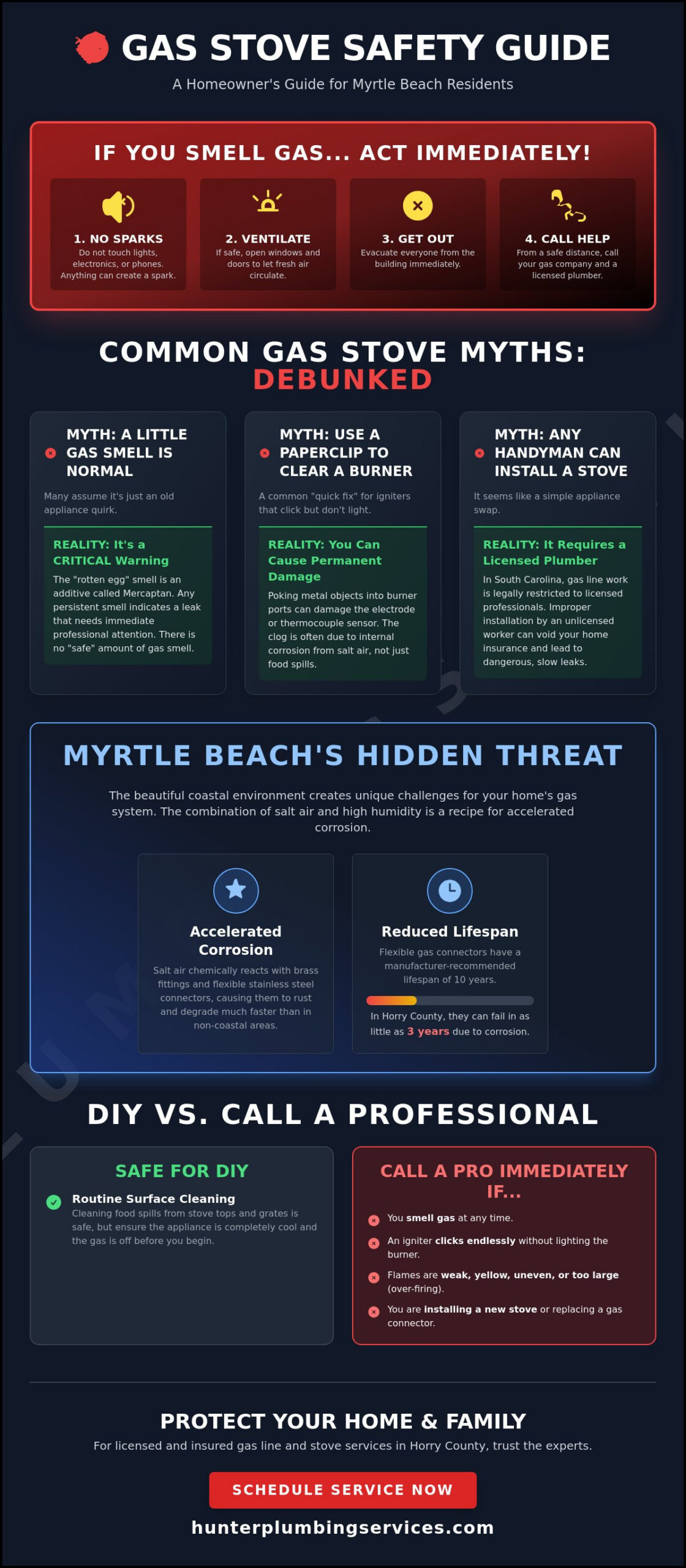
Gas companies add mercaptan to natural gas and propane to give it a distinct sulfur or rotten egg smell. This is a safety feature, not a suggestion. In coastal environments, humidity levels often stay above 70 percent. This constant moisture accelerates the oxidation of brass fittings and flexible connectors. A small leak today can become a major rupture tomorrow. Ignoring a persistent gas odor in a Myrtle Beach high-rise is a major safety violation because it puts every resident in the building at immediate risk. If you smell gas, don’t wait for it to go away. Turn off the supply and call a professional immediately.
Why DIY Burner Cleaning Isn’t Always the Answer
The Gas stove in your kitchen is a precision instrument. While many people suggest using a paperclip to clear a burner that won’t light, this often causes permanent damage. Clogged ports in our area are frequently caused by internal corrosion from salt air rather than just food spills. Shoving a metal wire into the port can bend the electrode or damage the thermocouple, which is the safety sensor that tells the stove it’s safe to release gas. A clicking igniter that won’t catch is often a sign of a failing spark module or a moisture-damaged ignition switch, neither of which can be fixed with a paperclip.
- Corrosion issues: Salt air reacts with the metal components, creating a crust that blocks gas flow.
- Electrical failures: High humidity can short out the ignition switches behind the control knobs.
- Pressure drops: If multiple burners have weak flames, the issue is likely your regulator or the main gas line.
Another common myth is that any handyman can safely swap out a unit. In South Carolina, gas lines and appliance connections require specific mechanical licensing and permits to ensure everything is up to code. Hiring an unlicensed worker can void your home insurance and lead to improper seals that leak over time. To understand exactly what credentials to look for, our licensed plumber for gas line hiring guide for Myrtle Beach walks you through South Carolina license requirements and how to avoid common pitfalls. Often, what looks like a simple gas stove repair is actually a symptom of larger gas line problems. Shifting sandy soil or aging exterior pipes can compromise your fuel supply, making it a job for a licensed expert who understands the unique Myrtle Beach terrain.
Why Gas Stove Issues Are Often Gas Line Issues
When you encounter a burner that won’t ignite, your first thought is probably the appliance itself. However, many “broken” stoves are actually suffering from supply issues. You must distinguish between the appliance mechanics, like knobs and timers, and the gas delivery system. The delivery system includes the valves, rigid lines, and pressure regulators that bring fuel into your kitchen. If the stove’s internal components are fine but the flame is weak or non-existent, you are likely looking at a plumbing problem rather than a mechanical failure.
The infrastructure behind your stove is just as important as the burners on top. Every gas stove requires a dedicated shut-off valve located directly behind the unit. This valve allows you to kill the fuel supply instantly during a gas stove repair or an emergency. We also pay close attention to flexible gas connectors. These stainless steel tubes are not permanent fixtures. Most manufacturers recommend replacing these connectors every 10 years. In our coastal environment, salt air can accelerate corrosion, making regular inspections vital for your home’s safety.
Plumber vs. Appliance Technician
Appliance technicians generally focus on the “box” or the shell of the stove. They replace spark igniters, heating elements, or digital displays. Hunter Plumbing focuses on the gas line installation and the overall safety of the fuel supply. In Horry County, local codes require a licensed plumber for any work involving the main gas line. We prioritize the integrity of the supply so your family stays protected from leaks or improper venting.
The Critical Role of Gas Pressure
Proper gas pressure is the heartbeat of your kitchen. Low pressure leads to weak, flickering flames that struggle to stay lit. On the other hand, a failing pressure regulator can cause “over-firing.” This results in dangerously large flames that can damage your cookware or start a fire. Our team uses specialized digital manometers to test line pressure during every service call. We ensure your appliance receives the exact British Thermal Units (BTUs) it was designed to handle. If you suspect your supply is inconsistent, contact our local team to verify your pressure levels and perform a professional gas stove repair assessment.
- Visual Check: Look for a steady blue flame; yellow or orange tips often signal a pressure or mixture issue.
- Valve Access: Ensure your shut-off valve is easy to reach and turns freely without sticking.
- Connector Age: If your flexible connector looks dull, kinked, or is over a decade old, replace it immediately.
The Impact of Myrtle Beach Salt Air on Gas Appliances
Living in the Grand Strand means dealing with high humidity and salt-laden air daily. These elements are a constant threat to your kitchen appliances. While stainless steel is often marketed as rust-proof, the salt air in Myrtle Beach can cause “pitting” corrosion in as little as 24 months. This process accelerates for marshfront and oceanfront properties where salt spray is most concentrated. Most major appliance brands consider this environmental damage, meaning your standard warranty won’t cover a gas stove repair caused by salt-induced failure.
Check your gas connections every 6 months for these warning signs:
- Orange or reddish flakes on the flexible connector.
- Stiff or brittle gas hoses that lack flexibility.
- Greenish patina on brass valves or fittings.
- Small “pits” or dark spots on the stove’s exterior.
Salt Air and Gas Line Integrity
Salt spray contains chloride ions that react aggressively with metal. When salt settles on your gas lines, it creates a localized electrochemical cell that eats through the material. Pay close attention to the transition points where gas lines enter your home from the exterior. These areas often trap moisture and salt, making them prime spots for leaks. If you see a “white crust” on your gas valves, don’t ignore it. This residue is a clear sign that corrosion is already compromising the seal and structural integrity of the fitting.
Protecting Your Kitchen from the Coast
If your home sits within 5 miles of the Atlantic, you need a proactive maintenance plan. Wipe down your stove and exposed gas lines with a damp cloth weekly to remove salt buildup. Professional leak detection is vital for coastal rentals to ensure guest safety and prevent property damage. For new installs, we recommend using epoxy-coated gas lines or stainless steel connectors with a protective polymer jacket. These materials provide an extra layer of defense against the relentless coastal environment. Regular inspections can save you from an emergency gas stove repair during peak tourist season when parts are harder to source.
Hunter Plumbing Services understands the unique challenges of coastal living. We focus on long-lasting solutions that keep your home safe from the corrosive effects of our beautiful environment. Trust our local expertise to keep your gas appliances running efficiently year-round.
Troubleshooting Your Gas Range: What’s Safe and What’s Not?
Most Myrtle Beach homeowners take pride in maintaining their own property. While cleaning your cooktop is a great weekend project, internal gas components are a different story. Understanding the boundary between a simple fix and a hazardous mistake keeps your family safe and your kitchen functional.
Safe to DIY:
- Cleaning burner caps and heads with a non-abrasive brush to remove food debris.
- Checking that the power cord is securely plugged into the 120-volt outlet.
- Resetting a tripped circuit breaker in your electrical panel.
- Replacing removable plastic control knobs.
Call a Pro Immediately:
- Replacing gas valves or internal manifolds.
- Adjusting the gas-to-air mixture shutters.
- Repairing a failed electronic igniter or spark module.
- Any task involving the disconnection of the flexible gas connector.
Precision is everything during a gas stove repair. Many DIYers reach for a standard pipe wrench when they see a leak, but this often makes the problem worse. Gas fittings are frequently made of soft brass. This metal strips or cracks easily under the pressure of the wrong tool. Professional technicians use specialized flare nut wrenches to distribute pressure evenly. A single hairline crack in a brass fitting can release enough gas to reach explosive levels in an enclosed kitchen within hours.
Homeowners often use the “Soapy Water Test” to find leaks by brushing a 50/50 mix of dish soap and water onto connections. If bubbles grow, there’s a leak. While this is a helpful baseline, it has limits. It won’t detect “micro-leaks” or internal valve failures that only occur when the oven is preheating. We use electronic combustible gas detectors that sense parts per million, providing a level of accuracy a bottle of Dawn simply can’t match.
Signs of Professional Repair Necessity
If your burners produce yellow or orange flames instead of a crisp, steady blue, stop using the appliance. A yellow flame indicates incomplete combustion, which produces carbon monoxide. According to the CDC, over 430 people die annually from accidental CO poisoning in the U.S. Watch for soot buildup on the bottom of your pans or the burner grates; this is a physical sign that your stove is “burning dirty.” Most importantly, if you smell a sulfur-like “rotten egg” odor when the stove is off, evacuate the home and call for help.
The Hidden Risks of DIY Gas Work
A small mistake in threading can lead to a catastrophic leak. Gas pipe threads are tapered, and even a 1/16th-inch misalignment can prevent a gas-tight seal. In South Carolina, performing unlicensed gas work can lead to significant legal and insurance headaches. If a fire occurs and investigators find the cause was an unpermitted, DIY gas stove repair, your insurance provider may deny the claim entirely. Saving $100 on a service call isn’t worth the risk of a house fire. When hiring help, make sure you’re working with a licensed plumber for gas line work in Myrtle Beach who meets all Horry County permit requirements. Our family-owned team ensures every connection meets local safety codes so you can cook with total peace of mind.
Professional Gas Line and Stove Services in Horry County
Hunter Plumbing Services treats gas safety with a rigorous standard of integrity. We recognize that a gas leak or a malfunctioning appliance isn’t just a minor inconvenience; it is a critical safety event for your household. Our team provides a dedicated 24/7 emergency response for suspected gas leaks across Myrtle Beach and the surrounding areas. If you detect the telltale smell of sulfur or hear a faint hissing sound near your range, we move quickly to secure your home. We operate on a neighborly service philosophy. This means we provide upfront pricing before any tools leave the truck. You will never face surprise charges or hidden fees during a stressful situation. We believe in clear communication and honest work, acting as your reliable partner in home safety.
Why Trust Hunter Plumbing with Your Gas System?
Our technicians possess deep experience with the unique coastal plumbing challenges found in South Carolina. Salt air is highly corrosive. It attacks metal fittings and gas connectors much faster than in inland environments. As a family-owned Myrtle Beach business, we have spent years witnessing how high humidity and salt spray degrade kitchen infrastructure. We don’t just fix the immediate problem; we look for signs of long-term wear that could lead to future hazards. Transparency is the cornerstone of our reputation. When you call us for a gas stove repair, our diagnostic process is thorough and documented. We explain the “why” behind every recommendation, ensuring you feel confident in the safety of your gas system. We take pride in our local roots and treat every customer like a member of the community.
Next Steps for a Safe Kitchen
A safe kitchen requires proactive attention. You can start by checking your gas shut-off valve today. It should move smoothly without resistance. If the handle feels seized or requires heavy force to turn, it has likely succumbed to coastal corrosion. Don’t force it yourself, as this can cause a leak. Preventative maintenance is significantly more affordable than emergency repairs or component replacements after a failure occurs. Small adjustments now prevent major hazards later. Consider these simple safety steps for your home:
- Inspect burner flames regularly; they should be steady and blue.
- Keep a fire extinguisher rated for grease and gas fires in an accessible spot.
- Ensure your kitchen has proper ventilation to prevent carbon monoxide buildup.
- Verify that your carbon monoxide detectors are less than five years old.
If you notice uneven heating or clicking sounds that won’t stop, you likely need a professional gas stove repair to prevent further damage. Our team is ready to help you maintain a high-performing kitchen. Contact Hunter Plumbing Services today to schedule your expert gas line and stove safety check. We are here to provide the peace of mind you deserve.
Protect Your Coastal Home with Expert Gas Services
Living along the Grand Strand brings unique challenges to your kitchen appliances. Data from the National Association of Corrosion Engineers indicates that salt-heavy coastal air can increase metal corrosion rates by up to 10 times compared to inland environments. This means your appliance connectors and gas lines face wear that standard troubleshooting won’t fix. Understanding the difference between a simple ignition glitch and a serious gas line obstruction is vital for your family’s safety. Don’t risk a DIY mistake when it comes to volatile fuel sources.
Hunter Plumbing Services provides the dependable gas stove repair and maintenance you need to keep your kitchen running effectively. As licensed and insured gas line experts, we offer 24/7 emergency service for Myrtle Beach and Conway to ensure you’re never left in a dangerous situation. You can count on our upfront, honest pricing with no hidden fees for every job we perform in Horry County. We’re ready to help you maintain a safe, efficient home through every season.
Schedule your professional gas safety inspection with Hunter Plumbing today!
Frequently Asked Questions
Is it safe to repair a gas stove myself if I turn off the gas?
Repairing a gas stove yourself is risky even if you turn off the main valve. Residual gas often remains in the lines, and improper reassembly can lead to slow leaks that standard carbon monoxide detectors might not catch immediately. According to the National Fire Protection Association, gas equipment issues contribute to thousands of home fires annually. Trust our family-owned team to handle your gas stove repair with professional tools and calibrated leak-detection technology.
Why does my gas stove smell like rotten eggs even when it is off?
A rotten egg smell indicates a gas leak because utility companies add a chemical called mercaptan to otherwise odorless natural gas. This scent acts as a warning signal that gas is escaping from a loose connection or a faulty valve. If you smell this, don’t flip any light switches or use electronics in the room. Open your windows and call a professional immediately to inspect the appliance and the supply lines.
What color should my gas stove flame be in a properly functioning unit?
Your gas stove flame should always be a steady, crisp blue. A blue flame indicates complete combustion, which means the gas is burning efficiently and safely. If you see yellow or orange streaks, it often means the burners are clogged with debris or the air-to-gas ratio is incorrect. This incomplete combustion can increase carbon monoxide levels in your kitchen, so schedule a service check if the flame color shifts.
How much does a typical gas stove repair or gas line inspection cost in Myrtle Beach?
National data from HomeAdvisor suggests that most homeowners pay between $150 and $400 for appliance repairs. Specific costs in Myrtle Beach depend on the parts needed and the complexity of the gas line access. We believe in honest, transparent communication, so we provide upfront pricing before any work begins. This ensures you aren’t surprised by hidden fees after the job is finished. Our goal is providing long-lasting solutions at a fair price.
Can salt air really cause my gas stove to leak?
Salt air accelerates the corrosion of metal components, which can lead to gas leaks over time. In coastal environments like Myrtle Beach, the sodium chloride in the air reacts with copper and brass fittings, causing them to pit and weaken. A 2022 study on coastal infrastructure confirms that metal degradation occurs up to 10 times faster near the ocean. Regular maintenance helps identify these weakened points before they fail completely and create a hazard.
How often should I have my gas lines and stove connections inspected in a coastal home?
You should have your gas lines and stove connections inspected at least once every 12 months. Annual checks are vital in South Carolina because high humidity and salt spray can degrade seals and flexible connectors faster than in inland areas. Our neighborly technicians look for signs of rust or brittle gaskets during these visits. This proactive approach prevents emergencies and extends the life of your kitchen appliances while keeping your family safe.
What should I do immediately if I suspect a gas leak in my kitchen?
Evacuate everyone from the home immediately and call your gas provider or emergency services from a safe distance outside. Don’t touch any electrical switches, use a phone inside the house, or start your car in the garage, as a single spark can ignite the gas. Once the area is secured by officials, contact Hunter Plumbing Services. We’ll provide a reliable gas stove repair to ensure your home is safe to re-enter.
Does Hunter Plumbing handle gas stove installations for new constructions?
Yes, our team handles professional gas stove installations for new construction projects throughout the Myrtle Beach area. We ensure every connection meets current South Carolina building codes and safety standards. Whether you’re building a custom home or a commercial kitchen, we provide the technical authority needed for a flawless setup. We take pride in being your local partner for safe, dependable gas line integration from the very first day you move in.