

In Myrtle Beach, water filtration is no longer a luxury; it’s the essential first line of defense for your home’s entire plumbing infrastructure. You’ve likely noticed the telltale signs of our coastal water issues. Maybe it’s the faint scent of rotten eggs in the shower or the white, crusty scale building up on your expensive tankless water heater. It’s frustrating to feel like you can’t even trust the water from your own tap for drinking or bathing. Investing in whole house water filtration Myrtle Beach homeowners can rely on is about more than just taste. It’s about protecting your property from the unique challenges of our local environment.
We understand that you want peace of mind when you turn on the faucet. You’ll discover how to eliminate sulfur odors, neutralize chlorine, and stop hard water from destroying your fixtures. This guide walks you through the latest 2026 standards for coastal water quality and helps you choose the right system to ensure crystal clear water for your family. We’ll show you how to extend the life of your plumbing while making your home a healthier place to live.
Key Takeaways
- Understand how the unique Grand Strand water profile impacts your plumbing and why a Point-of-Entry system is your best defense.
- Learn the differences between carbon filtration and water softening to determine which technology solves your specific water quality issues.
- Discover how to size a whole house water filtration Myrtle Beach system to maintain consistent water pressure, even during high-usage periods in vacation rentals.
- Identify why professional installation is critical for meeting South Carolina plumbing codes and ensuring proper backflow prevention.
- Find out how the right filtration setup extends the lifespan of expensive appliances like tankless water heaters by preventing mineral scale buildup.
Understanding Myrtle Beach Water Quality: Why Filtration Matters
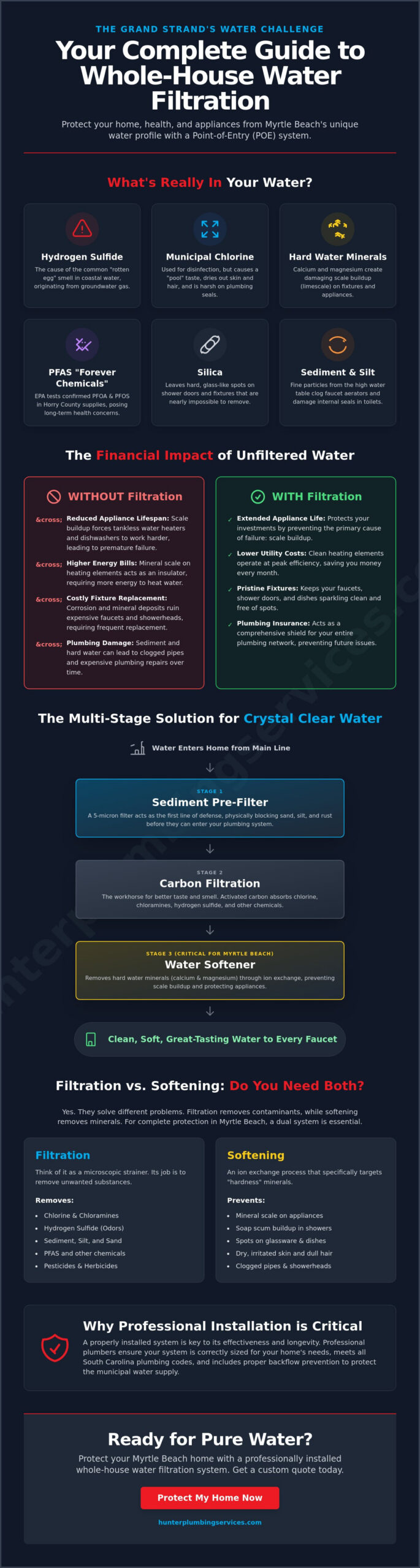
Myrtle Beach water presents a unique set of challenges that go beyond simple taste. A whole house water filtration Myrtle Beach system is a Point-of-Entry (POE) solution. This means it treats every drop of water the moment it enters your home’s main line. Instead of just filtering your drinking water, a POE system protects your dishwasher, laundry, and showers. The “Grand Strand Water Profile” is characterized by high mineral content and the heavy use of municipal chlorine. These factors work together to degrade your plumbing over time.
You’ve likely noticed the “rotten egg” smell common in coastal South Carolina. This odor comes from hydrogen sulfide gas trapped in our groundwater. When this sulfur combines with salt air and hard water minerals, it creates a “double whammy” for your property. While the salt air attacks your fixtures from the outside, the aggressive water quality corrodes them from the inside. This constant cycle of mineral buildup and corrosion leads to expensive repairs if left unaddressed.
Common Contaminants in the Grand Strand
Municipal treatment plants use chlorine and chloramines to keep water safe from bacteria, but these chemicals are harsh on your body. They strip natural oils from your skin and hair, often leading to irritation. Properties near the marsh or in areas with a high water table face additional issues with fine silt and sediment. Beyond the basics, local residents are increasingly concerned about specific substances found in Horry County supplies:
- PFAS: EPA testing conducted between 2023 and 2025 confirmed the presence of “forever chemicals” like PFOA and PFOS in the local water system.
- Silica: This mineral is prevalent in our sandy soil and leaves hard, glass-like spots on shower doors that are nearly impossible to scrub away.
- Sediment: Fine particles from the high water table can clog aerators and damage the internal seals of your toilets and faucets.
The Financial Impact of “Raw” Water on Your Home
Using untreated water is a gamble with your home’s value. Hard water scale is particularly destructive to tankless water heaters. As minerals bake onto the heating elements, the unit has to work harder, which spikes your energy bills and shortens the equipment’s lifespan. The cost of replacing high-end faucets and showerheads every few years often exceeds the investment in a reliable filtration setup. A professionally installed whole house water filtration Myrtle Beach system acts as a comprehensive insurance policy for your entire plumbing network.
Comparing Filtration Systems: Which One Is Best for Your Home?
Selecting a whole house water filtration Myrtle Beach system requires understanding the specific job each component performs. Most homeowners start with a sediment filter. These act as the physical gatekeepers for your property. We typically install 5-micron filters to catch the fine silt and sand common in coastal South Carolina. Without this first step, larger particles can clog your fixtures and wear down the internal seals of your appliances.
Carbon filtration is the next essential layer. It’s the primary solution for neutralizing the heavy chlorine and chloramines used in municipal treatment. While chlorine keeps water safe from bacteria, it makes drinking water taste like a swimming pool and dries out your skin. For properties in Conway or Longs that rely on private wells, we often recommend adding UV purification. This technology uses ultraviolet light to neutralize bacteria and viruses without adding any chemicals to your supply.
Filtration vs. Softening: Do You Need Both?
It’s important to distinguish between filtration and softening. Filtration removes chemicals and odors, while softening addresses the minerals that cause hard water. Because Myrtle Beach water is moderately hard, a water softener is necessary to prevent scale buildup. We often install “dual-stage” systems in local luxury homes to provide the best of both worlds. You can choose between salt-based systems, which are highly effective at removing minerals, or salt-free conditioners that require less maintenance but don’t actually remove the hardness ions.
Reverse Osmosis: The Final Step for Drinking Water
While a whole-house system protects your pipes, many families add a point-of-use Reverse Osmosis (RO) system under the kitchen sink. RO provides a final level of polishing for cooking and drinking water by removing up to 99% of remaining dissolved solids. This combination ensures your entire home is protected while giving you bottled-quality water at the tap. If you are considering a Tankless Water Heater Installation, remember that soft water is its best friend. Preventing mineral scale is the only way to keep those high-efficiency units running for their full expected lifespan. If you’re unsure which setup fits your needs, our team can help you evaluate your whole house filtration options based on your specific water source.
Choosing and Sizing a System for Your Coastal Property
Selecting the right whole house water filtration Myrtle Beach system depends heavily on your property’s specific demands. A common mistake is choosing a unit based solely on square footage. Instead, you must calculate the peak flow rate. A three-bathroom family home requires a much higher capacity than a small condo. If your system is undersized, you will experience a frustrating drop in water pressure whenever multiple faucets run at once.
The “Vacation Rental Factor” is a unique local consideration. If you own a short-term rental, your water system faces extreme usage spikes. Guests often return from the beach and use every shower, dishwasher, and washing machine simultaneously. Your filtration system must handle these high-volume bursts without failing. Additionally, since most Myrtle Beach homes lack basements, we usually install these systems in garages or exterior closets. The system casing must be high-quality and resistant to our salt-heavy coastal humidity to prevent premature corrosion.
Determining Your Filtration Needs
Every successful installation starts with a professional water test. This identifies exactly which contaminants are present so you don’t pay for filtration stages you don’t need. We look at peak usage times, such as the morning rush, to ensure the system maintains pressure. While you might notice “problem taps” with staining or odors, the solution starts at the main water line entry point to protect the entire house.
Long-Term Maintenance and Reliability
Maintenance is straightforward but vital for performance. Sediment filters usually need replacement every three to six months, while carbon media can last much longer depending on your water volume. If you notice a sudden drop in pressure or a return of that familiar sulfur smell, it’s time for service. Adding a new filtration system involves new plumbing connections. We recommend Professional Leak Detection to ensure every new fitting is secure and your walls remain dry. If you want to ensure your home has the best protection possible, let us help you find the right whole house filtration solution for your specific needs.
Professional Installation: Why the Plumber Matters
Installing a whole house water filtration Myrtle Beach system involves more than just cutting a few pipes. It requires a deep understanding of your home’s hydraulics and local plumbing infrastructure. While DIY kits are available, an improper installation often leads to significant water damage or a drop in household pressure. A licensed professional ensures that your bypass valves are positioned correctly, allowing you to service the system without cutting off water to your entire home.
Compliance with South Carolina plumbing codes is another critical factor. We focus on proper backflow prevention to ensure that filtered water cannot siphon back into the municipal supply. Our team also looks at the big picture. We integrate your new filtration unit with your existing equipment, including gas lines and water heaters. This holistic approach prevents unexpected leaks and ensures your property remains safe and code-compliant.
At Hunter Plumbing, we prioritize Neighborly Service and Financial Clarity. We don’t believe in hidden fees or confusing jargon. Instead, we provide a clear, upfront explanation of the work required and the costs involved. It’s our way of offering a verbal handshake to our community, ensuring you feel confident that your property is in capable hands.
The Hunter Plumbing Installation Process
We follow a logical, three-step process to ensure your system performs at its peak from day one:
- Step 1: Main Line Assessment: We perform a thorough pressure test on your incoming line. This confirms that your chosen filtration system won’t cause a frustrating loss of flow at your showerheads or faucets.
- Step 2: Custom Mounting and Bypass Loop: We install a dedicated bypass loop. This professional touch is vital because it allows you to change filters or perform maintenance without interrupting your home’s water supply.
- Step 3: Post-Installation Testing: Once the system is live, we test the water at various taps. This verifies that the contaminant reduction is meeting the 2026 standards we’ve promised.
Peace of Mind for Myrtle Beach Homeowners
Our commitment doesn’t end when the installation is finished. We provide reliable support for your entire plumbing system, giving you a dependable local partner to call if issues arise. Because our coastal environment is so aggressive, we use corrosion-resistant materials for every mounting and fitting. This is especially important for units located in garages or exterior closets where salt air can quickly degrade standard hardware. We build our systems to last, protecting your investment for the long term.
Schedule your whole house filtration consultation with Hunter Plumbing today to start protecting your home.
Secure Your Property with Professional Water Protection
Your home is likely your largest investment. Protecting it from the aggressive mineral scale and chemical contaminants found in our local supply is a smart financial move. You now understand how a whole house water filtration Myrtle Beach system acts as a shield for your appliances, pipes, and fixtures. By removing sulfur odors and neutralizing chlorine, you aren’t just improving your water’s taste; you’re extending the life of your entire plumbing infrastructure.
Hunter Plumbing is proud to be your local partner in Horry County. We are fully licensed and insured, specializing in the specific plumbing challenges that come with living on the coast. Whether you need 24/7 emergency support or a custom filtration installation, our team provides the financial clarity and dependable workmanship you deserve. Don’t wait for hard water scale to damage your expensive tankless heater or corrode your faucets.
Contact Hunter Plumbing Services for a Whole House Filtration Quote and enjoy the peace of mind that comes with crystal clear water from every tap. We look forward to helping you protect your home for years to come.
Frequently Asked Questions
Is a whole house water filter the same as a water softener?
No, these systems perform two different jobs for your home. A filter removes contaminants like chlorine, sediment, and chemicals, while a softener specifically targets minerals like calcium and magnesium that cause scale. Many Myrtle Beach homeowners choose to install a combined system to handle both chemical tastes and hard water buildup. This dual approach provides the most complete protection for your plumbing and appliances.
How much does a whole house water filtration system cost to install in Myrtle Beach?
The total investment for a professional installation depends on several factors, including the number of filtration stages and your home’s specific plumbing layout. A basic sediment filter costs less than a comprehensive multi-stage system that includes UV purification or softening. We provide clear, upfront estimates after a site visit so you have full financial clarity before any work begins on your property.
Will a water filtration system reduce my water pressure?
A properly sized system won’t cause a noticeable drop in your household water pressure. We carefully calculate your home’s peak flow rate in gallons per minute to ensure the unit can handle simultaneous usage, like running the dishwasher while someone is showering. If you install an undersized unit, you may experience pressure issues, which is why professional sizing is so important for local homes.
How often do I need to change the filters in my whole home system?
Maintenance schedules vary based on the type of media and your household water volume. Most sediment pre-filters need a change every three to six months to keep the water flowing freely. Carbon filters and other specialized media generally last between six and twelve months. Keeping up with these changes ensures your whole house water filtration Myrtle Beach system remains effective and protects your pipes from debris.
Does Myrtle Beach city water really need a whole house filter?
Yes, because municipal treatment often leaves behind chlorine, chloramines, and trace contaminants that can irritate your skin. Recent EPA testing also confirmed the presence of PFAS in local supplies, which standard city treatment isn’t designed to eliminate. A whole house system acts as a final barrier, removing these substances and protecting your family from the “legal but not necessarily ideal” levels of chemicals in city water.
Can a whole house filter remove the sulfur smell from my well water?
Yes, specialized filtration systems are highly effective at neutralizing the “rotten egg” smell caused by hydrogen sulfide gas. This issue is common in Horry County groundwater and requires specific media like catalytic carbon or oxidation filters. Once installed, these systems strip the gas from your water supply, ensuring that every shower and glass of water in your home smells fresh and clean.