

What if the “clean” water entering your home is actually the biggest threat to your family’s health and your plumbing’s lifespan? You aren’t alone if you’ve noticed that sharp, swimming pool smell in your kitchen or felt your skin get itchy and dry after a long soak. Most Myrtle Beach homeowners already know our coastal water is notoriously hard, which is why whole house filtration has become a necessity rather than a luxury. In fact, local mineral levels can lead to scale buildup that reduces appliance efficiency by up to 30% in just a few years. It’s frustrating to watch your expensive fixtures lose their shine while you worry about what’s actually in every glass you drink.
We believe you deserve better than just “meeting standards.” Investing in the right system ensures that every drop of water, from the laundry room to the master bath, meets bottled-water quality. This 2026 guide explains how to protect your pipes, extend the life of your water heater, and finally get the soft hair and healthy skin you’ve been missing. We will walk you through the specific contaminants found in the Grand Strand area and help you choose the right solution for your home’s unique needs.
Key Takeaways
- Understand why a Point-of-Entry system is the only way to ensure every drop of water in your home is clean and safe.
- Protect your plumbing and expensive appliances from the harsh effects of chlorine and sediment common in coastal water.
- Learn how to select the right whole house filtration system by calculating your home’s specific flow rate and water source needs.
- Discover why professional installation from a local expert is critical for maintaining warranties and preventing future leaks.
- See how a professional bypass setup simplifies maintenance, keeping your water fresh with minimal effort.
What is Whole House Filtration and Why Does Myrtle Beach Need It?
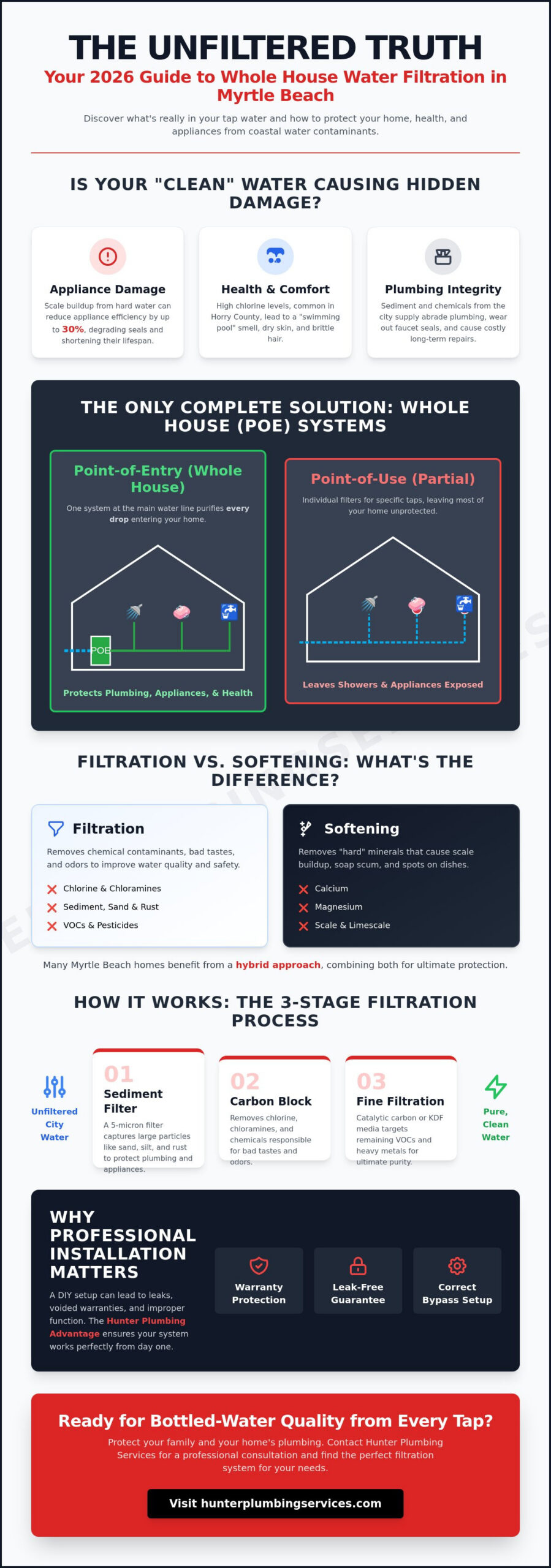
Whole house filtration is a Point-of-Entry (POE) system designed to treat every drop of water that enters your home. Unlike Point-of-Use (POU) options, such as refrigerator filters or countertop pitchers, a POE system sits at the main water line. This means your shower, laundry, and dishwasher all receive the same high-quality water as your kitchen tap. Understanding how water filters work helps homeowners realize that treating water at the source is the only way to protect the entire plumbing infrastructure from chemical wear and sediment buildup.
In Myrtle Beach, our “coastal water profile” presents unique challenges. Because we live in a low-lying region with a high water table, municipal treatment plants must use robust disinfection methods. Local utilities often rely on chlorine and chloramines to ensure water remains safe as it travels through miles of piping to reach your front door. While these chemicals are necessary for safety, they often leave behind a distinct “heavy” feel and a noticeable scent that many residents find unpleasant.
The Difference Between Filtering and Softening
It’s common to confuse filtration with softening, but they serve two different purposes for your home. Filtration focuses on removing contaminants like chlorine, chloramines, volatile organic compounds, and sediment. Softening specifically targets mineral hardness, such as calcium and magnesium, which cause scale buildup in your water heater and spots on your dishes. Many Grand Strand homes benefit from a hybrid approach that combines both technologies to address the specific chemical and mineral makeup of our local supply.
The primary goal of whole-house systems in 2026 is to provide a comprehensive barrier against chemical disinfectants and sediment before they enter your home’s internal plumbing network.
Local Water Quality Concerns in Horry County
If you’ve ever stepped into the shower and smelled a “swimming pool” scent, you’ve experienced the high chlorine levels common in Horry County. This chemical presence can dry out skin and hair while also degrading rubber seals inside your toilets and appliances. Coastal geography plays a major role here; our proximity to the ocean and the complex network of local waterways means source water often contains high levels of organic matter. This requires local treatment plants to maintain high disinfectant residuals to keep the water supply stable.
- Metallic Aftertastes: Often caused by older infrastructure or specific mineral concentrations in the groundwater.
- Chloramine Persistence: Unlike standard chlorine, chloramines don’t dissipate easily and require specialized carbon filtration to remove.
- Annual Reports: We always recommend that neighbors check their local 2025 or 2026 Consumer Confidence Reports to see exactly what the utility is tracking.
Investing in whole house filtration ensures that your family isn’t the final filter for the city’s water. By removing these elements at the door, you protect your home’s value and improve your daily quality of life.
How Whole House Water Filtration Systems Work
Your water’s journey begins at the main service line where it enters your property. Without a whole house filtration system, every contaminant from the municipal supply flows directly into your water heater, dishwasher, and showerheads. These systems act as a comprehensive gatekeeper, treating water at the point of entry so every tap in your home delivers clean results. This centralized approach ensures that you aren’t just filtering what you drink, but also what you use to cook and bathe.
The process relies on a series of specialized barriers. First, water passes through a pre-filter designed to catch physical solids. This stage stops sand, silt, and rust flakes that often break loose from aging city infrastructure. By removing these abrasives, you prevent premature wear on your faucet seals and internal appliance components. It’s a simple step that saves significant money on long-term plumbing repairs. Once the physical debris is gone, the water moves into the chemical treatment phase.
The 3-Stage Filtration Process Explained
The standard 3-stage whole house filtration setup is the most common choice for local families. It provides a balanced approach to safety and performance through the following steps:
- Stage 1: Sediment Removal. This initial 5-micron filter captures large particles that cloud your water. It protects sensitive equipment like tankless water heaters from clogging and losing efficiency.
- Stage 2: Carbon Filtration. Using a process called adsorption, activated carbon stages pull dissolved chemicals out of the water. This is where the system neutralizes chlorine, pesticides, and volatile organic compounds (VOCs) that affect both safety and smell.
- Stage 3: Fine Polishing. The final stage uses a dense media to catch microscopic impurities. This ensures the water is crystal clear, odorless, and tastes exactly how it should.
Advanced Technologies: UV and Scale Inhibition
Standard filters handle chemicals and solids, but some Myrtle Beach homes require extra protection. If your water source is a private well or if you’re concerned about biological safety, UV purification is a powerful addition. This technology uses specific light wavelengths to neutralize 99.9% of viruses and bacteria by scrambling their DNA. It provides a level of safety that physical filters alone cannot match.
Scale inhibition is another modern solution for coastal homeowners. Unlike traditional softeners that use salt, these systems treat minerals so they don’t stick to your pipes. You won’t deal with the slippery, “slimy” feeling of salt-treated water, but your pipes stay free of hard water buildup. While you’re upgrading your system, it’s a great time to check for hidden issues with leak detection to ensure your new filtration setup isn’t wasting water. If you’re ready to improve your home’s water quality, our team can help you select the right system for your needs.
Beyond Better Taste: Protecting Your Coastal Plumbing
While many Myrtle Beach residents install whole house filtration to improve the flavor of their tap water, the mechanical benefits are often more critical for the home’s health. Municipal water systems frequently use chlorine as a primary disinfectant. While this keeps water safe from bacteria, it is incredibly aggressive toward your plumbing components. Chlorine causes the rubber seals and flappers in your toilets to become brittle and fail. It also eats away at the O-rings in your faucets. This leads to silent leaks that can waste over 3,000 gallons of water a year in a single household. By removing these chemicals at the main entry point, you preserve the internal components of every fixture in your home.
Sediment is another silent killer for modern coastal homes. High-efficiency dishwashers and washing machines use precision valves and sensors that often fail when exposed to fine sand or grit. A 2023 industry report found that sediment buildup can reduce the operational efficiency of these appliances by up to 15% within the first two years of use. Protecting these expensive investments requires a barrier that catches debris before it enters your internal supply lines. This keeps your appliances running at peak performance and prevents the need for early replacements. Hard water and sediment also accelerate wear on kitchen sink appliances, making garbage disposal replacement a more frequent and costly necessity for coastal homeowners who skip whole house filtration.
Your piping material is also at risk. Chemical imbalances in untreated water contribute to the development of pinhole leaks in copper pipes and can cause premature degradation in certain PEX formulations. Installing a whole house filtration system stabilizes the water chemistry. This significantly lowers the risk of hidden water damage behind your walls, which is a common and costly issue in our humid coastal environment. Stabilizing your water chemistry also reduces pressure fluctuations that can stress components like your expansion tanks, making proactive repair and maintenance even more important for long-term plumbing health.
Preserving Your Tankless Water Heater
Clean water is a non-negotiable requirement for a successful tankless water heater installation. These units rely on compact heat exchangers that are highly sensitive to mineral scale and sediment. Even a thin layer of buildup forces the unit to run hotter and longer. This extra stress shortens its lifespan and spikes your energy bills. Filtration prevents this scale from forming on the heating elements. This reduces the frequency of required professional flushes from once every 12 months to once every 36 months, which keeps more money in your pocket.
Reducing Long-Term Maintenance Costs
The “hidden” cost of poor water quality adds up quickly through frequent fixture replacements and emergency service calls. For those building new homes, clean water helps maintain the integrity of the rough in plumbing from the very first day. You don’t want your brand-new pipes compromised by harsh local water before you’ve even settled in. Think of filtration as a comprehensive insurance policy for your entire plumbing network. It keeps your water flowing and your repair bills low by acting as a shield against the elements that cause wear and tear.
Choosing the Right Filtration System for Your Grand Strand Home
Selecting the right whole house filtration setup requires a clear plan. You don’t want to guess when it comes to your family’s health and plumbing longevity. Every home in Myrtle Beach has unique needs based on its age, location, and usage habits. Follow these four steps to find the perfect fit for your property.
- Step 1: Identify your water source. City water users usually deal with chemical additives, while private well owners face mineral and bacterial issues.
- Step 2: Calculate your flow rate. This is measured in Gallons Per Minute (GPM). It determines if your system can keep up when multiple taps are open.
- Step 3: Get a professional water test. A lab analysis identifies specific contaminants like high iron, lead, or volatile organic compounds.
- Step 4: Pick your maintenance level. Decide between simple cartridge systems that require manual swaps or automatic backwashing tanks that clean themselves.
Sizing Your System Correctly
An undersized system is a common mistake that leads to frustrating drops in water pressure. If your filter can’t process water as fast as you use it, your morning shower will feel like a weak trickle. For a standard 2-bathroom home in Myrtle Beach, we recommend a system rated for at least 7 to 10 GPM. Larger 4-bathroom coastal properties often require 15 to 20 GPM to maintain steady pressure.
You must consider “peak demand” for multi-story homes. This is the total water volume needed when the dishwasher, washing machine, and two showers run simultaneously. Proper whole house filtration sizing ensures you never have to choose between clean water and a strong flow.
City Water vs. Well Water Solutions
City water systems focus heavily on removing chlorine and disinfection byproducts. These chemicals keep water safe during transport but leave a harsh smell and dry out your skin. We use carbon-based media to pull these chemicals out before they reach your tap. If you notice your fixtures are constantly backing up, a plumber for drain cleaning can clear out existing sediment before you install your new system.
Well water systems require a different approach. They must target iron, manganese, and that distinct “rotten egg” sulfur smell. We also look for tannins, which are organic materials that tea-stain your laundry and toilets. These systems often use air injection or specialized resin beds to neutralize minerals and odors at the source. Pairing clean water with a professional toilet installation in Myrtle Beach is especially important for well water users, since the corrosive minerals in untreated water can rapidly degrade toilet mounting hardware and internal components.
Don’t settle for hard, smelly water in your home. Contact the local experts at Hunter Plumbing Services today for a professional water quality consultation.
Professional Installation: The Hunter Plumbing Advantage
Choosing the right system is only half the battle. Proper installation of your whole house filtration system ensures it performs as promised for decades. Many homeowners consider a DIY approach to save money, but this often leads to expensive setbacks. Most high-end filtration manufacturers explicitly state that a licensed plumber must perform the setup to keep the warranty active. Without that professional stamp, a component failure could leave you paying for repairs out of pocket. A small mistake during a DIY install can result in a 50-gallon-per-minute leak, causing thousands in water damage within an hour.
We install a dedicated bypass loop with every system we service. This three-valve configuration is a game changer for homeowners. It allows you to divert water around the filters if you need to perform repairs or if you are filling a swimming pool and don’t want to exhaust your filtration media. We also prioritize pressure regulation. Myrtle Beach municipal water pressure can fluctuate significantly. If your home’s PSI exceeds 80, it can damage the internal seals of your filtration tanks. Our team tests your incoming pressure and installs a regulator if necessary to protect your investment. Unregulated pressure spikes can also accelerate wear on other components throughout your system, which is why we always recommend pairing pressure management with proper expansion tank repair and maintenance to prevent costly water heater and plumbing failures.
Hunter Plumbing stands by a commitment to honesty and upfront pricing. We provide a clear quote before any work begins, so there are no surprises on your final bill. We treat every Grand Strand neighbor with the same integrity we would show our own family members.
What to Expect During Installation
The process begins by tapping into your main water line, typically located near the primary shut-off valve. We secure the heavy filtration tanks to a reinforced base or wall mount. In our coastal environment, we use corrosion-resistant fittings to handle the high humidity and salt air. Once the pipes are set, we run a series of flow tests. We check for leaks under full pressure and verify that your gallons-per-minute rate meets the needs of your household appliances and showers.
Maintenance and Long-Term Support
Your whole house filtration system needs regular attention to stay efficient. We recommend a consistent maintenance schedule to keep your water tasting great:
- Sediment Pre-Filters: Replace these every 3 to 6 months to prevent sand and silt from Clogging the main system.
- Main Carbon Media: These tanks typically require replacement every 5 to 7 years.
- Performance Checks: If you notice a drop in water pressure or the return of chlorine odors, it is time for a service call.
Chlorine and hard minerals that bypass filtration don’t just affect your water quality — they also corrode the internal hardware of your bathroom fixtures. Homeowners who delay filtration often find themselves needing toilet installation in Myrtle Beach sooner than expected, as salt air and untreated water accelerate the decay of mounting bolts and wax seals in coastal bathrooms.
Don’t leave your water quality to chance. Contact Hunter Plumbing for a water quality assessment today and ensure your home has the protection it deserves.
Secure Your Home’s Future with Clean Water
Protecting your Myrtle Beach property starts at the main water line. In Horry County, installing a whole house filtration system is the most effective way to eliminate sediment and chemical residues that prematurely age your plumbing. By 2026, coastal homeowners will increasingly rely on these advanced systems to extend the lifespan of water heaters and protect high-end fixtures from corrosive mineral buildup. You deserve a filtration solution that fits your family’s specific health needs and budget requirements.
Hunter Plumbing Services is a family-owned and locally operated business that understands the unique water challenges facing the Grand Strand. We provide 24/7 emergency support for our neighbors and guarantee upfront, transparent pricing with no hidden fees. Don’t let poor water quality damage your pipes or your peace of mind. Our team combines technical expertise with the reliable, neighborly service you expect from a local partner who values long-term relationships.
Get a Professional Water Quality Assessment from Hunter Plumbing Services today to ensure your home stays safe and efficient for years to come.
Frequently Asked Questions
Is a whole house filtration system worth the investment in Myrtle Beach?
Yes, investing in a whole house filtration system provides long-term protection for your family’s health and plumbing. Myrtle Beach water contains between 1.5 and 2.1 parts per million of chlorine according to 2024 water quality reports. This system removes these chemicals before they reach your skin in the shower. It also prevents sediment from clogging your fixtures, which can extend the life of your appliances by 25 percent over 10 years.
Will a whole house filter reduce my water pressure?
A system sized to your home’s specific flow rate won’t noticeably reduce your water pressure. Most modern units are designed to maintain a flow rate of 10 to 15 gallons per minute, which meets the needs of a three bathroom home. If you notice a drop of more than 5 pounds per square inch, your filter’s likely clogged or undersized. Our team ensures your whole house filtration setup matches your peak water usage.
How long do whole house water filters typically last?
Your filter’s lifespan depends on the specific component and your local water usage. Sediment pre-filters usually require replacement every 3 to 6 months to prevent buildup. Main carbon tanks typically last between 5 and 10 years or 1,000,000 gallons of water. We recommend checking your pressure gauges monthly. A 10 percent drop in pressure often indicates it’s time for a new cartridge to maintain peak performance and keep your water clean.
What is the difference between a water softener and a water filter?
Approximately 65 percent of our Myrtle Beach clients install both systems to achieve total protection against both hard water damage and chemical impurities. A water softener specifically targets minerals like calcium, while a filter removes contaminants like chlorine. Softeners use ion exchange to prevent scale buildup in your pipes. Filters use various media to improve taste. This combination protects your skin and your plumbing from different types of damage.
Can I install a whole house filtration system myself?
You can install a basic unit if you have advanced plumbing skills, but professional installation ensures your system meets South Carolina residential plumbing codes. Incorrect DIY setups often lead to leaks or bypass issues that void your manufacturer’s warranty. Our licensed plumbers handle the heavy lifting, including the necessary bypass valves and drain lines. This guarantees your whole house filtration system operates safely without risking property damage from a burst pipe.
Does a whole house filter remove fluoride from my tap water?
Standard carbon filters don’t remove fluoride from your home’s water supply. To eliminate fluoride, you need a specialized system utilizing activated alumina or a whole-house reverse osmosis unit. The Grand Strand Water and Sewer Authority maintains fluoride levels around 0.71 milligrams per liter to meet CDC recommendations. If you want this removed, we can customize your filtration media to target fluoride specifically during the installation process to meet your specific needs.
How do I know which size system my home needs?
You determine the correct size by calculating your home’s peak flow rate and the diameter of your main water line. A typical 2,000 square foot home with 2.5 bathrooms usually requires a system with a flow rate of at least 12 gallons per minute. We measure your port size, which is typically 0.75 inches or 1 inch in Myrtle Beach homes. Choosing a system that matches these specs prevents pressure loss during demand.
What maintenance is required for a whole house water system?
Maintenance involves scheduled filter cartridge replacements and an annual professional inspection of all seals and valves. You should swap out your sediment filters every 90 to 180 days depending on your water’s turbidity levels. We also suggest cleaning the filter housing during every change to prevent bacterial growth. Keeping a detailed log of your maintenance dates helps ensure your system provides clean water for its full 10 year life cycle without interruption.